
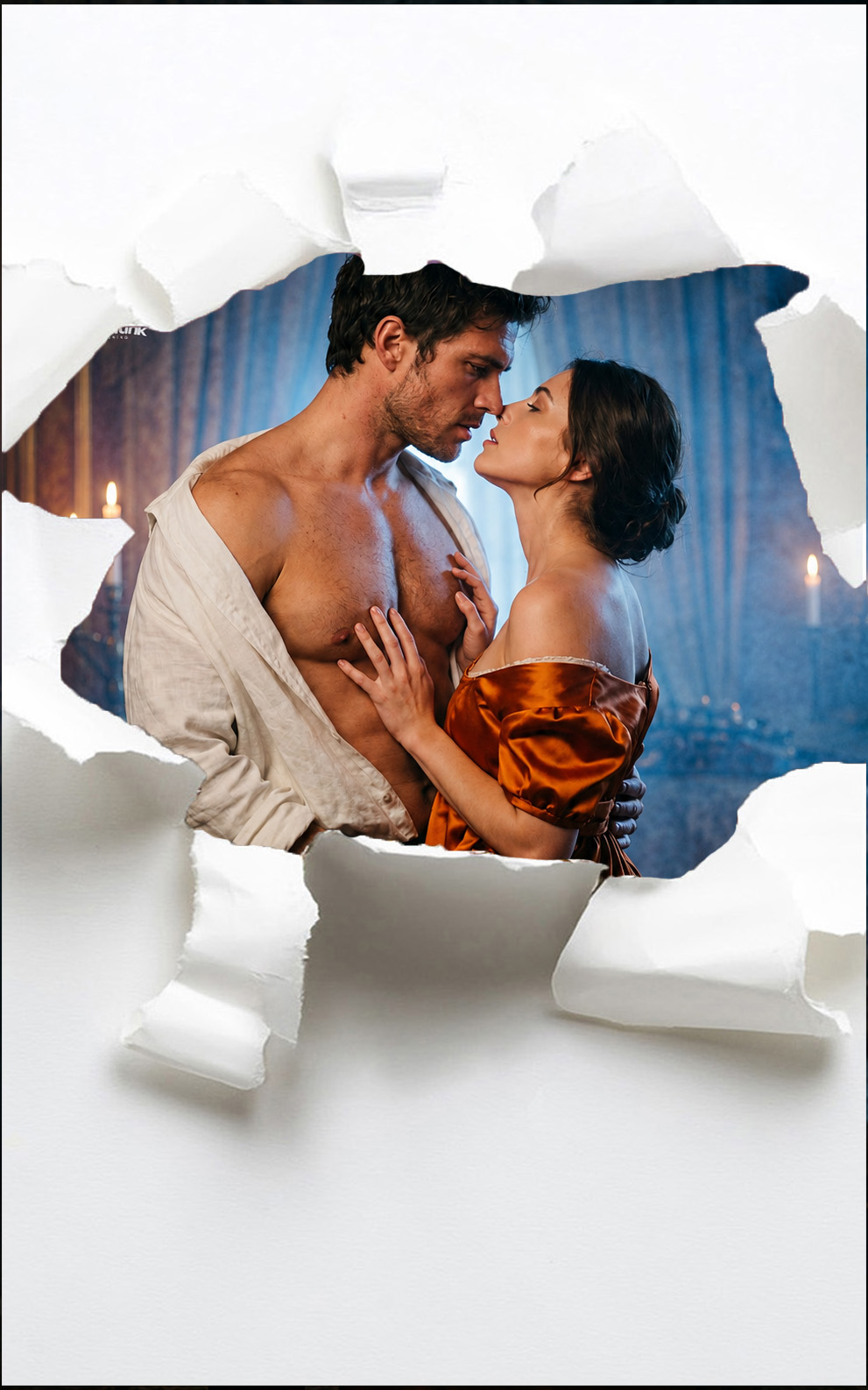
Chapter One
“You look as though you’d rather be anywhere else.”
William Bradworth, Duke of Hollowshade, accepted a glass of champagne from a passing footman and raised an eyebrow at Lord Worthington, who had materialised at his elbow with the persistence of a man who had known him too long to be intimidated by his reputation.
“I would rather be anywhere else,” William confirmed. “I would rather be at my club, drinking brandy that costs more than most men’s annual income. I would rather be at the opera, where at least the performances are intentional. I would rather be in my bed with…” He paused, considering. “Well. With anyone who isn’t currently in this ballroom.”
“And yet here you are.” Worthington’s eyes gleamed with amusement. “At the first major ball of the Season. Surrounded by debutantes and their ambitious mamas. Looking, if I may say, rather like a wolf who has wandered into a sheep pen and isn’t certain whether to feast or flee.”
“Your metaphors need work.”
“Your attendance needs explanation. You never come to these things, Will. Not this early. You usually wait until the Season is half-dead before deigning to appear, by which point the most desperate mothers have already married off their daughters and the remainder have learned not to expect anything from you.”
William took a sip of champagne, adequate, though not exceptional, and surveyed the glittering expanse of the Worthington ballroom. Crystal chandeliers blazed overhead, casting their light across a sea of pale muslin and dark evening coats. The orchestra was competent. The flowers were excessive. The assembled company was exactly what he had expected: a marriage market dressed in silk and pretence, every smile calculated, every conversation a negotiation conducted in the currency of bloodlines and bank accounts.
He had attended a thousand events exactly like this one. He knew every variation, every permutation, every possible configuration of ambitious mother and marriageable daughter. He could predict with reasonable accuracy which young ladies would simper, which would flirt, which would affect disinterest in hopes of intriguing him. He had seen it all before.
It bored him unto death.
“I was restless,” he said finally, which was not quite a lie. “The alternative was an evening at home with my own thoughts, which I did not find appealing.”
“Your thoughts must be dark indeed if you prefer this.” Worthington gestured at the crowd. “Look at them. Circling. Assessing. That woman in puce has been edging toward us for the past five minutes, dragging her unfortunate daughter behind her like a sacrifice to the gods of matrimony.”
William glanced at the woman in question, Lady Something-or-Other, he could not recall the name, and watched her trajectory with detached amusement. She was indeed approaching, her path a masterwork of social navigation that would deposit her directly in his orbit within moments.
“I give her thirty seconds,” Worthington murmured.
“Twenty. She’s determined.”
“Shall we retreat?”
“And deprive her of the opportunity to parade her daughter before us? That seems cruel.” William’s lips curved. “Besides, I find myself curious to see this year’s offerings. Perhaps there will be something… unexpected.”
Worthington snorted. “There is never anything unexpected. There are diamonds and there are wallflowers and there is everything in between, and none of them is any different from the diamonds and wallflowers of last year, or the year before, or the year before that.”
“You are unusually cynical this evening.”
“I am merely realistic. As are you, usually. What has got into you?”
William did not answer, because he did not have an answer. He did not know why he had come tonight. He did not know why, for the past several weeks, he had felt a growing restlessness, an itch beneath his skin that neither wine nor women nor any of his usual diversions could scratch. He was thirty-two years old, wealthy beyond reason, titled beyond reproach, and absolutely, catastrophically bored with his own existence.
This was not a new feeling. He had been bored for years, decades, perhaps. But lately the boredom had taken on a sharper edge, a quality of desperation that unsettled him. He found himself going through the motions of his life, the clubs, the mistresses, the endless social engagements, without any sense that any of it mattered. Without any sense that he mattered, except as a title to be coveted and a fortune to be captured.
Not that he would ever admit this to anyone. The Duke of Hollowshade did not have existential crises. He had champagne and cynicism and a reputation that preceded him into every room he entered.
Speaking of which.
“Your Grace!” Lady Puce had arrived, slightly breathless, her daughter in tow. The daughter was blonde, pretty in a conventional way, and looking at William with an expression he recognised intimately: calculation disguised as admiration. “What an unexpected pleasure! I did not know you would be attending this evening.”
“Neither did I,” William said pleasantly. “And yet here we are, both of us surprised by my presence.”
The daughter giggled. The mother’s smile flickered with uncertainty, she could not quite tell if she was being mocked, before resettling into determined brightness.
“May I present my daughter, Miss Amelia Crawford? She has just come out this Season, and I know she would be honoured to make your acquaintance.”
Miss Crawford curtsied with practised grace. Her eyes, when they met his, held exactly what he expected: awareness of his reputation, interest in his title, and a complete absence of anything resembling genuine feeling.
She was pretty.
She was available.
She was utterly interchangeable with a hundred other girls he had met over the years.
“Charmed,” William said, and meant none of it. He exchanged the required pleasantries, deflected the mother’s increasingly pointed hints about dances and promenades, and extricated himself as soon as politeness permitted.
“That was almost kind,” Worthington observed as they retreated toward the relative safety of the terrace doors. “You usually dispatch them more brutally.”
“I am feeling generous tonight.”
“You are feeling something. I’m not certain it’s generosity.”
William did not respond. He was scanning the room again, that restless survey that had become habitual, looking for something he could not name. Something different. Something that might, for even a moment, make him feel less like a ghost haunting his own life.
His gaze moved across the crowd, cataloguing and dismissing with practised efficiency. Diamonds in their white gowns, sparkling and identical. Matrons in their silks, watching and calculating. Young bucks posturing near the entrance, their cravats tied in increasingly ridiculous configurations. Wall of ferns near the corner, behind which—
He stopped.
There was a girl behind the ferns.
Not hiding, exactly, she was too visible for true concealment, but definitely positioned for minimum exposure. She was holding a glass of lemonade with an expression that suggested it had personally offended her, and she was watching the ballroom with an air of bemused detachment that William recognised because he wore it himself.
She was not beautiful. That was the first thing he noticed. Her features were pleasant but unremarkable, brown hair, modest figure, the sort of face one might describe as ‘agreeable’ before moving on to more interesting subjects. She was dressed appropriately but not fashionably, her gown a simple cream muslin that did nothing to distinguish her from the dozens of other young ladies in similar attire.
There was absolutely no reason for him to be looking at her.
And yet.
Something about her posture caught his attention. The way she stood apart from her companions, close enough to appear social, distant enough to suggest she’d rather be elsewhere. The way her eyes moved across the room with what appeared to be genuine curiosity rather than strategic assessment. The way she seemed to be studying the assembled company as though they were specimens in a naturalist’s collection rather than potential allies or rivals in the great game of social advancement.
She was watching the room the way he watched the room.
With distance. With detachment. With the faint air of someone who had wandered into a foreign country and was still learning the customs.
Interesting.
William let his gaze linger, waiting for her to notice. Women always noticed when he watched them. It was one of the few reliable constants in his experience, the moment when awareness flickered through their eyes, when their posture shifted, when they began the performance that his attention inevitably triggered.
The girl looked up.
Their eyes met across the crowded ballroom.
And she looked away.
William blinked.
She had looked away. Not with the calculated disinterest of a woman playing at coyness, not with the nervous flutter of a debutante overwhelmed by his attention. She had simply… looked at him, registered his existence, and returned her gaze to the far more fascinating lemonade in her hand.
As though he were furniture.
As though he were boring.
“Will?” Worthington’s voice seemed to come from very far away. “What are you staring at?”
“Her.” William nodded toward the ferns. “The girl by the plant. Brown hair, cream gown. Who is she?”
Worthington squinted across the room. “I… believe that’s Miss Hayfield? Country family, Devonshire. First Season. Middling dowry, respectable connections, nothing remarkable.” He paused. “Pleasant enough face.”
“She looked away from me.”
“I beg your pardon?”
“Our eyes met. She looked away.” William could hear the bemusement in his own voice and did not bother to hide it. “When was the last time that happened?”
“I… cannot recall.” Worthington’s brow furrowed. “Lady Rutherford at the Devereaux ball, perhaps?”
“Lady Rutherford is sixty-three and nearly blind.”
“Still. She did look away.”
“Because she couldn’t see me, Worthington. This girl saw me perfectly well. She simply chose not to continue looking.”
The concept was so foreign that William found himself turning it over in his mind like a puzzle box, searching for the mechanism that would reveal its secrets. Women did not look away from him. They looked at him, with hunger, with calculation, with fear, with challenge, but they looked. His attention was a commodity, and anyone who received it understood its value.
Except, apparently, Miss Hayfield of Devonshire.
“Perhaps she didn’t recognise you,” Worthington offered.
“Everyone recognises me.”
“Perhaps she’s not interested in dukes.”
“Everyone is interested in dukes.”
“Perhaps…” Worthington stopped, a slow smile spreading across his face. “Perhaps she’s simply not interested in you.”
The suggestion should have been amusing. Instead, it landed with unexpected weight.
Not interested in him.
The idea was preposterous. William knew exactly what he looked like, exactly what he had to offer, exactly why women found him compelling. He was handsome, devastatingly so, according to more than one discarded mistress, and wealthy beyond measure and possessed of one of the oldest titles in England. He was charming when he chose to be, witty when the situation demanded it, and skilled in arts that young ladies were not supposed to know existed.
No woman was “not interested” in him. They might pretend disinterest. They might calculate the advantages of appearing aloof. But underneath the performance, they were always interested.
Weren’t they?
He looked at Miss Hayfield again. She was speaking to one of the other girls now, Miss Thornbury, if he wasn’t mistaken, nodding along to whatever tedious conversation was occurring while her eyes continued their detached survey of the room.
She did not look in his direction again.
Perhaps it’s a strategy, he thought. Perhaps she’s been advised that indifference intrigues. Perhaps she’s playing a longer game than the others.
This was the most logical explanation. Women were performers, every one of them. His mother had taught him that lesson early, and the years since had only confirmed it. The appearance of sincerity was simply another mask, sometimes more sophisticated than the obvious ones, but a mask nonetheless.
Miss Hayfield was probably performing right now. Pretending to be uninterested because she understood that his interest was aroused by what he couldn’t easily have.
And yet.
Something about her didn’t fit the theory. The way she held herself. The expression on her face when she thought no one was watching. The complete absence of the subtle positioning, the angled shoulders and lifted chins, that characterised women who wanted to be noticed.
She genuinely seemed to wish she were elsewhere.
“I am going to speak to her,” William heard himself say.
Worthington choked on his champagne. “You are what?”
“The girl. Miss Hayfield. I am going to introduce myself.”
“Will, she’s a debutante. First Season. Respectable family. Not your usual—”
“My usual has grown tedious.” William set down his champagne glass and straightened his cuffs. “Perhaps I require variety.”
“Variety in the form of innocent young ladies is the sort of variety that ends in marriage or scandal. Neither of which you want.”
“I have no intention of marrying her.” William’s voice was dry. “Or ruining her. I simply wish to discover why she looked away.”
“That seems like a dangerous curiosity.”
“All curiosities are dangerous. That’s what makes them interesting.”
He left Worthington spluttering and made his way across the ballroom.
The crowd parted for him as it always did. He registered the attention, the whispers, the flutter of fans, the careful repositioning of ambitious mamas, and dismissed it as background noise. His focus was fixed on the girl by the ferns, who was still holding her lemonade with an expression of mild suffering and had not once glanced in his direction.
Up close, she was… interesting.
Not beautiful, as he had already established. But there was something compelling about her face that he had not been able to see from across the room. Intelligence, perhaps, in the way her eyes moved. Or character, in the stubborn set of her jaw. She was not blank and pleasant like so many of the debutantes he encountered. There was something there, something active and engaged beneath the surface.
She was also, he noticed, not wearing gloves. She had removed them at some point, and her bare hands cradled the lemonade glass with an informality that was technically improper and somehow utterly charming.
There was an ink stain near her thumb.
A woman who wrote things down. How novel.
“Miss Hayfield?”
She startled. Actually startled, her lemonade sloshing dangerously, and she turned to face him with wide eyes and flushing cheeks. The blush was immediate and uncontrollable, he could see it spreading from her face down to the neckline of her gown, and something shifted in William’s chest.
That blush was not performed.
He would stake his entire fortune on it.
“I believe we have not been introduced,” he continued, watching her with an attention that felt suddenly more focused than it had been in years. “But I observed you from across the room and found myself quite unable to resist the urge to remedy that deficiency. I am Hollowshade.”
He watched her process the name. Watched the flicker of recognition, the brief calculation, the decision being made behind those brandy-brown eyes. She was not stupid, that much was immediately clear. She knew who he was. She knew what his approach meant, in the language of the ton.
And she did not simper. Did not flutter. Did not assume any of the poses he had expected.
She curtsied, proper, precise, betraying the hours of practice that had gone into its execution, and met his eyes directly.
“Miss Eliza Hayfield. And I am not certain, Your Grace, that propriety permits us to converse without a formal introduction.”
It was a challenge. A gentle one, wrapped in politeness, but a challenge nonetheless. She was pushing back, and she was doing it to him, and William felt something spark in his chest that he had not felt in a very long time.
“Propriety,” he repeated, letting amusement colour his voice. “Do you find yourself much concerned with propriety, Miss Hayfield?”
“I find myself much concerned with avoiding scandal, Your Grace. Which I am given to understand amounts to the same thing.”
“Ah.” His lips curved. “You have been warned about me.”
She did not flinch. Did not look away. “I have been warned about rakes in general, Your Grace. You are merely… a specific instance of a general category.”
William stared at her.
And then he laughed.
It was not the practised chuckle he deployed for social occasions. It was an actual laugh, surprised, genuine, escaping before he could contain it. When had anyone last surprised a laugh out of him? He could not remember.
“A specific instance of a general category,” he repeated. “I do not believe anyone has ever described me thus.”
“Then perhaps your acquaintance has been insufficient in natural philosophers.”
“My acquaintance has been deficient in a great many things.” He held her gaze, and something electric passed between them, a current of awareness that made his skin prickle. “Tell me, Miss Hayfield, what do the natural philosophers say about my… category?”
“They say that specimens of your type are best observed from a safe distance.” Her chin lifted slightly, and he saw a flash of spirit beneath the proper exterior. “Preferably behind glass.”
“And yet here you stand. Without any glass between us at all.”
He stepped closer. It was a calculated move, one he had made a thousand times, but when her breath caught, he felt the impact in his own chest. A sympathetic response. An involuntary reaction. As though her body’s response to his proximity had somehow become his own.
This was not how seduction usually felt.
“I was not aware that you were approaching,” she said, and her voice was slightly breathless in a way that sent heat curling through his belly. “Had I been, I would certainly have sought appropriate protective barriers.”
“Ah. So your disengagement was not a strategy.” Something loosened in his chest, relief, perhaps, though he was not certain why. “You genuinely wished to avoid my attention.”
“Is that so surprising?”
“In my experience, Miss Hayfield, young ladies at balls do not generally avoid the attention of dukes.”
“Then perhaps your experience has been deficient in ladies capable of independent observation.”
She was magnificent.
The thought rose unbidden, and William shoved it aside with something approaching alarm. He did not think women were magnificent. He thought them beautiful, occasionally clever, frequently tedious. But magnificent implied admiration, and admiration implied respect, and respect implied…
He did not finish the thought.
“You are not what I anticipated,” he said instead.
“I cannot imagine what you anticipated, Your Grace, given that we had not met.”
“That is precisely my point.” He allowed himself to study her, the scatter of freckles across her nose, the ink stain on her thumb, the way her eyes met his without the coy evasion he had come to expect. “I saw you across the room, standing apart, watching the crowd as though it were a curiosity rather than a society you belonged to. You looked… distinctly unimpressed.”
“I was assessing the relative quality of the ferns,” she said, and there was a thread of humour in her voice that made him want to pull it, to see what would unravel. “This ballroom has quite a varied collection.”
“Ferns.”
“I have a keen interest in botany.”
“Do you indeed.”
His voice had dropped without his permission, taking on a quality that was far too intimate for a public ballroom. He saw her register it, saw the deepening of her blush, the slight parting of her lips, and felt an answering heat in his own body.
She has never been kissed.
The knowledge came to him with sudden, absolute certainty. This was not the reaction of a woman accustomed to male attention. This was something rawer, more fundamental, the response of a body awakening to sensations it had never experienced.
She was innocent. Truly innocent. Not performing innocence as a strategy, not affecting naivety to intrigue him. She simply had no experience of men, no armour against attraction, no defences against what was happening between them right now.
The realisation should have made him retreat. She was exactly the sort of woman he avoided, the kind whose ruin would be genuine, whose heart could be truly broken. Whatever game he was playing, it needed to stop here.
Instead, he stepped closer still.
“And what have you concluded?” he asked, and his voice came out rougher than intended. “About the ferns?”
“That they are the most sensible inhabitants of this room.” Her voice was slightly unsteady, but she held her ground. “They ask nothing, expect nothing, and provide excellent cover for those of us who find large social gatherings somewhat overwhelming.”
The admission surprised him. It was too honest, too vulnerable, for the conversation they had been having. She was not supposed to show him weakness. She was supposed to maintain the verbal sparring, the careful distance of wit.
“You are overwhelmed?” he heard himself ask.
“I am… unused to London, Your Grace. In Devonshire, one is not required to perform quite so constantly.”
“Perform?”
“Surely you of all people understand performance.”
It was a blade slipped between his ribs, elegant, precise, and uncomfortably accurate. “You believe I perform?”
“I believe everyone here performs, Your Grace. The difference is merely in the quality of the acting.”
“And my acting? How would you rate it?”
“I have not observed enough to form a judgment.” Her eyes met his, and there was something in them he could not quite read. “Though I suspect it is quite accomplished.”
For a long moment, William simply looked at her. This girl, this country nobody with her ink-stained fingers and her botanical metaphors, had seen through him in five minutes of conversation. Had identified, with devastating precision, the central fact of his existence: that he was performing, always performing, and had been for so long he was no longer certain what lay beneath.
No one saw through him. He had made certain of that.
And yet here she stood, looking at him as though his masks were made of glass.
“You are a curious creature, Miss Hayfield,” he said softly.
“I do not believe I am curious at all, Your Grace. I believe I am quite ordinary.”
“No.” The word escaped before he could stop it. “No, I don’t think you are.”
He took her hand.
It was an impulse, reckless, uncharacteristic, and the contact of his bare fingers against her ungloved hand sent a shock through his entire body. Her skin was warm. Soft. Her fingers trembled in his grasp, and when he bowed over her hand, bringing his lips close enough to feel the heat of her skin without quite touching, he heard her sharp intake of breath.
He wanted to kiss her hand properly. He wanted to turn it over and press his lips to her palm, to her wrist, to the flutter of pulse he could feel beneath her skin. He wanted to pull her closer and discover whether the rest of her was as warm as her fingers, whether she would tremble all over if he touched her properly.
He did none of these things.
But it cost him more than he cared to admit.
“I hope,” he said, and his voice did not sound like his own, “that we shall have occasion to continue this fascinating discussion of botany, Miss Hayfield. I find myself suddenly quite interested in… specimens.”
He released her hand. Stepped back. Turned and walked away before he could do something genuinely foolish.
The rest of the evening passed in a blur.
William performed the expected rituals, dancing with appropriate partners, making appropriate conversation, allowing Lady Chelmsford to press against him during a waltz with all the subtlety of a battering ram. He smiled. He charmed. He was, by all external measures, exactly the man everyone expected him to be.
But some part of his attention remained fixed on the girl by the ferns.
He watched her laugh at something Miss Thornbury said, a genuine laugh, unguarded, that transformed her face into something approaching lovely. He watched her decline a second dance with a young buck, her expression polite but firm. He watched her watching him, once, across the crowded room, and when their eyes met, she looked away again.
Again.
As though his attention were something to be escaped rather than captured.
“You’re still staring,” Worthington observed, appearing at his elbow with two glasses of brandy.
William accepted one and drank deeply. “I am contemplating.”
“Contemplating what? How best to ruin a country innocent?”
“She’s not…” He stopped. Started again. “I have no intention of ruining anyone.”
“Then what is your intention?”
William stared into his brandy, watching the amber liquid catch the candlelight. He did not have an answer. He did not understand his own fascination, why this particular girl, this particular evening, had lodged beneath his skin like a splinter he could not remove.
Perhaps it was simply novelty. He had grown bored with women who wanted him, and here was one who apparently did not. The chase was everything; the capture merely concluded the entertainment.
Then why, asked a voice in his head, can you still feel the warmth of her hand?
He left early. Claimed fatigue, which no one believed, and escaped into his carriage before he could do something he would regret. The streets of London slid past his window, dark and indifferent, and William sat alone with his thoughts.
She had not been performing.
He was almost certain of it now. Whatever masks she wore, they were not the calculated constructions of a woman playing at innocence. She was simply… herself. Uncomfortable, overwhelmed, stubbornly honest in a world that rewarded artifice.
Or, whispered the voice of long experience, she’s simply better at it than the others. Better at seeming genuine. More sophisticated in her manipulation.
His mother had been like that. Beautiful, charming, utterly convincing in her devotion, right up until the moment she’d walked away without looking back.
All women perform, he reminded himself. All of them. The ones who seem real are simply the most dangerous.
This was the truth he had built his life around. The armour he had constructed to protect himself from becoming his father, destroyed by love, hollowed out by trust, a ghost in his own house for the last fifteen years of his life.
William would not be destroyed.
William would not trust.
William would take what pleasure he wanted and offer nothing in return, and if Miss Eliza Hayfield of Devonshire was hurt in the process, well, she had been warned.
This is what he told himself as the carriage stopped before his townhouse. This is what he repeated as he dismissed his valet and stood alone before the window of his bedroom, staring out at the darkened city.
He would forget about her. He would return to his usual pursuits. He would find a widow or a bored wife or anyone who understood the rules of the game he played.
She is nothing, he thought. A country nobody with a sharp tongue and an unfortunate tendency to blush. There are a hundred women more beautiful, more sophisticated, more suited to your tastes.
All of this was true.
None of it explained why, as he finally climbed into bed and closed his eyes, it was not his usual fantasies that filled his mind.
It was brown hair catching candlelight.
It was the tremble of fingers in his grasp.
It was a voice saying surely you of all people understand performance, cutting through every defence he had ever built.
Damn, he thought.
And then, more softly: Who are you, Eliza Hayfield?
He did not sleep well.
And when dawn finally came, grey and unwelcome through his curtains, he knew, with a certainty that settled into his bones like an ache, that he would see her again.
Not because he wanted to.
Because he could not seem to help himself.
Chapter Two
“You are not hiding, I hope?”
Eliza Hayfield startled so violently that her lemonade sloshed over the rim of her glass, narrowly missing the ivory silk of her gown. She turned to find her cousin Beatrice regarding her with the particular expression of a woman who had attended six London Seasons and considered herself an expert on all matters matrimonial.
“I am not hiding,” Eliza said, though she was, in fact, standing behind a rather substantial potted fern. “I am… appreciating the foliage.”
“The foliage.” Beatrice’s eyebrow arched with devastating precision. “At the Worthington ball. The most anticipated event of the Season.”
“It is a very fine fern.”
“Eliza.”
“The fronds are particularly verdant.”
Beatrice sighed the sigh of a woman whose patience had been tested by country cousins before. She was three-and-twenty, golden-haired, and possessed of the sort of elegant cheekbones that made gentlemen write terrible poetry. Eliza, by contrast, was one-and-twenty, brown-haired, and possessed of the sort of face that gentlemen generally described as “pleasant” before inquiring about her dowry.
“You cannot secure a husband from behind a plant,” Beatrice said.
“I am not trying to secure a husband. I am trying to survive the evening without treading on anyone’s feet or saying something inappropriate about the refreshments.”
“What could you possibly say that would be inappropriate about the refreshments?”
Eliza considered the question. “I was thinking of mentioning that the ratafia tastes rather like something one might use to remove stains from upholstery.”
“You see, this is precisely why Mama stationed me to watch you.” Beatrice took Eliza’s arm with the firm grip of a woman who had successfully navigated six Seasons without a single scandal. “Come. You must circulate. You must be seen.”
Eliza allowed herself to be led from behind the fern, though she cast it a look of longing as she went. The ballroom stretched before her like a glittering battlefield, and she was woefully unequipped for the campaign.
This was her first London Season, her earlier years having been spent in the quieter rounds of county society, and she had discovered within approximately seven minutes of arriving in Town that she was spectacularly unsuited for it.
It was not that she lacked social graces. Her mother had ensured she could dance adequately, converse politely, and pour tea without drowning anyone. It was simply that she found the entire enterprise exhausting. Every conversation required performance. Every smile had to be calibrated. Every interaction was a negotiation conducted in a language she had never quite learned to speak.
At home in Devonshire, she could walk through the village and speak to people about actual things, the weather, the harvest, whether Mrs Whitmore’s goat had escaped again. Here, conversation seemed designed to communicate nothing while implying everything. It was like trying to read a book written in invisible ink, and everyone else had been given the formula for making it visible except her.
Beatrice deposited her among a cluster of young ladies, Miss Thornbury, Miss Cavendish, and others whose names blurred together, and disappeared to fulfil whatever mysterious obligations occupied women who had mastered the Season’s arts.
The conversation was about ribbons.
Eliza nodded along, her attention drifting across the ballroom with the detached curiosity of a naturalist observing wildlife. She catalogued details: the dowagers clustered near the refreshments like a murder of particularly well-dressed crows, the young bucks preening by the entrance with cravats tied in increasingly improbable configurations, the careful choreography of mothers positioning daughters for maximum visibility.
It was all rather fascinating, really, when one viewed it as an anthropological study rather than a marriage market in which one was expected to participate.
She was contemplating a gentleman whose shirt points were so high that he could not turn his head when she felt it.
A prickle at the back of her neck. A sudden awareness of being watched.
She looked up.
And met a pair of grey eyes across the crowded ballroom.
The impact was immediate and unsettling. She did not know who he was, not yet, but something about the intensity of his gaze made her breath catch. He was tall, dark-haired, and looking at her with an expression she could not quite name. Not the polite assessment of a gentleman evaluating potential dance partners. Something more focused. More deliberate.
As though he had been searching for something and had, against all expectation, found it.
Eliza’s instinct was to look away.
So she did.
She returned her attention to her lemonade, her heart beating faster than the occasion warranted. It was nothing. He was probably looking at someone behind her, Miss Thornbury, perhaps, who was genuinely pretty, or one of the other young ladies whose names she had already forgotten. There was no reason for a man like that, whoever he was, to be staring at a country nobody hiding behind decorative foliage.
But she could still feel his gaze. A weight on her skin. A presence she could not ignore no matter how determinedly she studied her glass.
“Hollowshade,” Miss Thornbury breathed beside her, and the name rippled through their little group with obvious significance. “The Duke of Hollowshade.”
Miss Cavendish’s fan accelerated to dangerous speeds. “Mama said he never attends events this early in the Season.”
“They say he’s had more mistresses than Lord Byron,” Miss Thornbury whispered. “And that he once seduced a married countess during her own dinner party.”
“I heard it was two countesses,” Miss Cavendish countered. “Sisters.”
The gossip continued, each revelation more scandalous than the last, but Eliza barely heard it. She was too aware of the man himself, his presence in the room like a disturbance in the air, drawing attention the way a flame drew moths.
She should not look at him again.
She absolutely should not—
“Miss Hayfield?”
The voice came from directly beside her, and it was low, rich, touched with amusement. Eliza turned, and suddenly the Duke of Hollowshade was there, close enough that she could smell something subtle and expensive, close enough that she could see the individual threads of silver in his grey eyes.
He was devastating. There was no other word for it. Sharp cheekbones, a jaw that could cut glass, and a mouth curved with the particular confidence of a man who knew exactly the effect he produced.
“I believe we have not been introduced,” he said, “but I observed you from across the room and found myself quite unable to resist the urge to remedy that deficiency. I am Hollowshade.”
He said it like a gift. Like she should be grateful for the offering.
Some contrary part of Eliza refused to be grateful.
“Miss Eliza Hayfield.” She curtsied, because that was what one did. “And I am not certain, Your Grace, that propriety permits us to converse without a formal introduction.”
His eyebrows rose, just slightly, just enough to suggest she had surprised him. “Propriety. Do you find yourself much concerned with propriety, Miss Hayfield?”
“I find myself much concerned with avoiding scandal, Your Grace. Which I am given to understand amounts to the same thing.”
What followed was the strangest conversation Eliza had ever had.
He was charming, of course he was charming; his reputation practically required it, but there was something beneath the polish that she had not expected. A genuine curiosity. A willingness to engage with her words rather than simply waiting for his turn to speak. When she called him “a specific instance of a general category,” he laughed, actually laughed, surprise breaking through his careful façade, and for a moment, he looked almost… human.
They spoke of botany. Of ferns. Of performance and masks and the exhausting theatre of London society. He asked questions that felt like genuine inquiries rather than gambits in some game she did not understand. And throughout, his grey eyes never left her face, watching her with an intensity that made her skin feel too tight for her body.
She should have been frightened. She should have been on guard.
Instead, she found herself talking. Actually talking, not performing the pale imitation that passed for conversation in ballrooms. She told him she found London overwhelming. She accused him of performing. She said things she should not have said, honest things, vulnerable things, and he did not mock her for any of them.
At some point during their exchange, he had stepped closer. Close enough that she could feel the warmth radiating from his body. Close enough that when she breathed, she caught that subtle scent again, sandalwood and something darker, something that made her think of midnight and secrets.
For a moment, neither of them spoke.
His gaze held hers, steady and intent, and something tightened low in her stomach.
And then he took her hand.
Her ungloved hand, she had removed her gloves for the lemonade and forgotten to replace them, and the contact of his bare fingers against her skin sent a shock through her entire body. Heat flooded through her, rushing up her arm and spreading through her chest, pooling low in her belly in a way she had never experienced and did not understand.
He bowed over her hand, his lips hovering close enough that she could feel the warmth of his breath without quite making contact. Her pulse raced. Every nerve in her body seemed fixed upon that single point of contact: his fingers against hers, his breath against her skin, the impossible nearness of his lips above her knuckles.
When he straightened, there was something in his eyes that made her stomach flip.
“I hope we shall have occasion to continue this fascinating discussion of botany, Miss Hayfield,” he said, his voice rougher than before. “I find myself suddenly quite interested in… specimens.”
Then he was gone, melting back into the crowd, and Eliza was left standing with her heart pounding and her hand tingling and absolutely no idea what had just happened.
She should have recovered quickly.
It was only a conversation. Five minutes, perhaps ten, of verbal sparring with a notorious rake who probably had similar conversations with a dozen women each evening. There was nothing remarkable about it. Nothing that should have left her standing frozen among the ferns, staring at her own hand as though it belonged to someone else.
And yet.
She could still feel him. The ghost of his touch. The warmth of his proximity. The way his voice had dropped when he’d asked about the ferns, taking on a quality that made her think of things she did not have names for.
What is wrong with me?
She retrieved her gloves from where she had abandoned them and pulled them on with trembling fingers. The silk felt wrong against her skin, a barrier where there had been none, a reminder of the contact that had passed between them.
Miss Thornbury appeared at her elbow, eyes bright with curiosity. “What did he say to you?”
“I… we discussed botany.”
“Botany?” Miss Thornbury’s expression suggested this was the least likely topic imaginable. “For all those minutes?”
“He seemed interested in ferns.”
“Hollowshade is not interested in ferns.” Miss Thornbury’s voice dropped to a whisper. “Hollowshade is interested in women. And he spent a very great deal of time talking to you, which means…”
“It means nothing.” Eliza’s voice came out sharper than intended. “He was bored, I was convenient, and now he has moved on to more interesting pursuits.”
But even as she said it, she felt his gaze on her again. That weight. That awareness. She looked across the room and found him watching her from beside Lord Worthington, his expression unreadable.
He was still looking at her.
Why was he still looking at her?
She made herself turn away. Made herself attend to Miss Thornbury’s chatter. Made herself appear as though she were not aware of the Duke of Hollowshade’s attention following her through the room.
The remainder of the evening passed in a blur of music and movement. She danced once, a country dance with a young gentleman whose name she immediately forgot, and spent the rest of the time refusing to look for him.
Not always successfully.
Every time she glanced across the ballroom, he was there. Not staring obviously, not making a spectacle of his interest, but present. Aware of her. His grey eyes would find hers for just a moment before she looked away, her cheeks burning, her pulse racing with something she could not name.
It was maddening. It was terrifying.
It was, she realised with dawning horror, thrilling.
This was what they warned about. This magnetic pull. This inability to think clearly in his presence, to maintain the distance that propriety required. Her mother’s letters, her aunt’s careful instructions, every piece of advice she had received about navigating the Season, all of it had included warnings about men like this.
Men who made you feel seen.
Men who made you feel special.
Men who could destroy you with a smile and a few well-chosen words.
She should be terrified.
She was not entirely certain that terror was the right name for what she was feeling.
***
The carriage ride home was silent.
Beatrice had questions, Eliza could see them burning behind her cousin’s carefully composed expression, but something in Eliza’s face must have discouraged inquiry. They sat in opposite corners of the carriage, swaying with the motion of the wheels, the gaslights of London sliding past the windows in a blur of amber and shadow.
Eliza pressed her forehead against the cool glass and closed her eyes. Her body felt strange, too warm, too aware, as though every nerve had been sensitised by the evening’s events. She could feel the rocking of the carriage in her bones. Could feel the whisper of silk against her skin with unusual intensity. Could feel, still, the phantom pressure of his fingers against her hand.
This is madness, she thought. I spoke to him for a handful of minutes. He held my hand for three seconds. There is no reason, no rational reason, for me to feel as though my entire world has tilted on its axis.
And yet.
A man had talked to her at a ball.
That was all. That was the entirety of the evening’s events, stripped of drama and significance. A man had talked to her, had held her hand for perhaps three seconds, had looked at her with attention that might have meant anything or nothing.
So why did she feel as though something fundamental had shifted?
She pressed her palm flat against her thigh, feeling the pressure through layers of silk and muslin. The hand he had held. The skin he had touched. She could still feel the echo of his fingers, could still conjure the exact sensation of his grip, firm but not forceful, warm, deliberate.
He has held a hundred hands, she reminded herself. A thousand. You are nothing special. You are merely the novelty of the evening, and by tomorrow, he will have forgotten your name.
This was certainly true. It was also, for reasons she could not articulate, unbearably painful to contemplate.
“Eliza.” Beatrice’s voice was gentle. “Are you quite all right?”
“Yes. Of course. Merely tired.”
“You look… unsettled.”
Unsettled. Yes, that was one word for it. There were others, overwhelmed, confused, terrified, wanting, but unsettled would do.
“It was a great deal of stimulation,” Eliza said. “I am unused to such events.”
Beatrice studied her for a long moment, then nodded slowly. “Mama will want to speak with you tomorrow. About the Duke.”
Eliza’s stomach clenched. “There is nothing to speak about.”
“There is always something to speak about where Hollowshade is concerned.” Beatrice’s voice held a warning that Eliza was not certain she understood. “He is not… he is not the sort of man one trifles with, Eliza. Nor is he the sort of man who trifles without purpose.”
If his attention continues.
The words hung in the air between them, unspoken but understood. Eliza should hope it did not continue. She should pray that tonight was an aberration, a momentary curiosity that would fade by morning.
She should want to be forgotten.
The truth, the terrible, shameful truth, was that she did not.
Sleep did not come easily.
Eliza lay awake in the narrow bed of her borrowed room, staring into the darkness.
The house had long since fallen silent, yet sleep remained stubbornly beyond reach.
She had changed out of her ball gown hours ago. Washed. Brushed out her hair. Done everything she ordinarily did before retiring. None of it had helped.
Her thoughts returned, with infuriating persistence, to the Duke of Hollowshade.
To the unexpected ease of their conversation. To the unsettling intensity with which he listened. To the warmth of his fingers against hers.
Most of all, to the moment she had accused him of performing.
Something had flickered across his face then. Surprise, perhaps. Or recognition.
As though she had glimpsed something he preferred remained unseen.
That, more than the flirtation, unsettled her.
Everyone knew what Hollowshade was. A rake. A libertine. A man whose reputation stretched across half of London. She ought to dismiss the evening as nothing more than a polished performance from a man who had spent years perfecting his charm.
Yet certainty eluded her.
She turned onto her side and closed her eyes. It was no use.
Every attempt at reason dissolved into the memory of grey eyes fixed upon her across a crowded ballroom.
This is madness, she thought. He held my hand for scarcely a moment. There is no rational reason for any of this.
And yet her pulse continued to misbehave whenever she recalled him.
Sometime before dawn, she drifted into uneasy dreams, filled with gathering storm clouds and distant thunder.
She woke unrested.
Morning brought a measure of clarity, though not comfort.
Whatever fascination she felt, it changed nothing. Hollowshade’s reputation had not been invented. Other women had undoubtedly believed themselves different. Wiser. Better able to resist.
She would not make the same mistake.
Or so she told herself.
When her aunt’s summons arrived before breakfast, delivered by a maid whose expression promised nothing pleasant, Eliza felt an inexplicable tightening in her chest.
She dressed with particular care and went downstairs.
Whatever awaited her, she suspected the previous evening was not yet finished with her.
Chapter Three
“We need to discuss the Duke of Hollowshade.”
Eliza’s teacup froze halfway to her lips. Across the breakfast table, Aunt Philippa sat with the particular expression of a woman who had unpleasant truths to dispense and intended to dispense them thoroughly.
It was half past nine in the morning. Eliza had slept poorly, dreams she could not quite remember but that left her feeling flushed and unsettled, and had come down to breakfast hoping for nothing more demanding than toast and silence.
She should have known better.
“Must we?” she asked, setting down her cup with careful precision.
“We must.” Aunt Philippa was fifty-three, silver-haired, and possessed of the sort of aristocratic bone structure that made her handsome rather than pretty. She had been widowed at thirty, had never remarried, and had spent the subsequent decades accumulating knowledge about London society the way other women accumulated jewellery. There was very little that escaped her notice, and absolutely nothing that escaped her commentary. “I observed you speaking with him last night. At some length.”
“It was only a few minutes.”
“A few minutes is an eternity when one is speaking with Hollowshade.” Aunt Philippa’s tone was clipped. “More than enough time for him to determine whether he finds you interesting enough to pursue. And from the way he watched you for the remainder of the evening, I would say he has reached a conclusion.”
Eliza’s heart performed an inconvenient flutter. “He watched me?”
“Do not look pleased about it.”
“I am not pleased. I am merely… concerned.”
“You should be alarmed.” Aunt Philippa set down her own teacup with a decisive click. “Eliza, I have known you since you were in leading strings. You are intelligent, sensible, and possessed of a moral compass that does you credit. But you are also innocent in ways that leave you vulnerable to men like Hollowshade.”
“Aunt.”
“Let me finish.” Philippa raised a hand. “I am not speaking of innocence in the… physical sense, though that is certainly relevant. I am speaking of innocence in matters of the heart. You have been raised by parents who love each other. You have seen only the best of what marriage can be. You believe, I know you believe, that love is a transformative force. That the right woman can change a man. That wickedness is merely a mask concealing wounded goodness beneath.”
Eliza opened her mouth to protest and found, uncomfortably, that she could not. Her aunt had described her beliefs with mortifying accuracy.
“It is a beautiful philosophy,” Philippa continued, her voice softening slightly. “And in many cases, it is even true. There are men who appear dissolute and are merely lonely. Men whose wildness conceals genuine hearts. Men who would, in fact, reform for the love of a good woman.” She paused. “Hollowshade is not one of them.”
“You cannot know that.”
“I can.” Philippa’s eyes held hers with uncomfortable intensity. “I knew his mother.”
The words landed in the quiet morning room with unexpected weight. Eliza found herself leaning forward slightly, drawn despite herself.
“His mother?”
“The late Duchess of Hollowshade. Eleanor Vane, before her marriage.” Philippa’s expression grew distant, touched with something that might have been pity. “She was the diamond of her Season. Beautiful, charming, utterly captivating. The old duke was besotted with her, married her within three months of their first meeting, gave her everything she desired, worshipped the ground upon which she walked.”
“That sounds… romantic.”
“It was tragic.” Philippa’s voice was flat. “Because Eleanor Vane was a consummate performer. She played the role of devoted wife for seven years, bore a son and heir, maintained every appearance of domestic felicity. And then she simply… left.”
Eliza blinked. “Left?”
“She had been conducting an affair with the old duke’s closest friend. A man named Thornwood, Baron Thornwood. When the duke discovered them together, Eleanor made no attempt at denial or repentance. She simply announced that she had never loved her husband, had found marriage tedious, and intended to live abroad with her lover.” Philippa’s mouth thinned. “She departed for Italy within the fortnight. The divorce was quiet, money can accomplish a great deal, but the scandal was… considerable.”
“And the duke?”
“Was destroyed. Utterly destroyed. I watched it happen, Eliza. Watched a strong, vital man collapse inward like a building with its foundations removed. He lived another fifteen years, but he was never the same. He barely spoke to his son, could not look at the boy without seeing Eleanor’s face. He retreated from society, from friendship, from everything that might have helped him heal. When he finally died, it was almost a mercy.”
Eliza thought of grey eyes watching her across a ballroom. Of a voice touched with private amusement. Of a man who moved through the world as though nothing could reach him.
“William Bradworth saw all of this,” she said quietly.
“William was eight years old when his mother left.” Philippa’s voice held no satisfaction, only a grim sort of certainty. “Eight years old when he learned that women perform love convincingly and leave anyway. Eight years old when his father stopped being able to look at him. He was raised by servants, educated by tutors, and shaped by the certain knowledge that emotional attachment destroys men.” She leaned forward. “Do you understand now? He is not a rake who might reform. He is a man who has decided, with full consciousness and deliberate intent, never to allow himself to love. Because loving made his father weak. Because trusting made his father foolish. Because he watched his mother’s betrayal hollow out his family and resolved never to permit anyone that power over him.”
The morning room felt suddenly cold. Eliza wrapped her hands around her teacup, seeking warmth that was not there.
“He seemed…” She paused, searching for the right word. “Not unkind.”
“He is not unkind. That is precisely the problem.” Philippa’s expression shifted to something approaching sympathy. “Hollowshade is charming, intelligent, and genuinely engaging. He can make you feel as though you are the most fascinating woman in any room. He will listen to your opinions. He will value your mind. He will treat you with a consideration that many husbands do not show their wives.” She paused. “And none of it will mean what you think it means.”
“I don’t understand.”
“He will make you feel special, Eliza. That is his gift, his curse, perhaps. He makes every woman feel special. But it is not because he cares for you. It is because he is skilled at reading what women want and providing it. He gives attention because attention keeps women willing. He gives consideration because consideration keeps women hoping. And when he grows bored, when the novelty fades, and you are no longer a puzzle he wishes to solve, he will withdraw that attention as easily as he bestowed it. And you will be left wondering what you did wrong, when the truth is you did nothing. You were simply… entertainment. A diversion. A pleasant way to pass the time until the next diversion appeared.”
Eliza’s throat felt tight. She thought of the way he had looked at her, that intensity, that focus, and wondered if she had imagined significance where there was only technique.
“He has left a trail of broken hearts,” Philippa continued. “Not ruined women, he is too clever for that, too careful of his own reputation if not of theirs. But women who believed they were different. Women who thought they saw something genuine beneath the charm. Women who woke one morning to discover that the man who had seemed so captivated by them had simply… moved on. Without explanation. Without apology. Without any acknowledgement that what they had shared had meant anything at all.”
“Perhaps they expected too much.”
“Perhaps they did.” Philippa’s voice was gentle now. “But that is the cruellest part, Eliza. He gives them reason to expect. He gives them hope. He makes them believe, and then he proves their belief foolish. And the shame of having been so wrong, of having seen love where there was only sport, that shame stays with a woman far longer than any scandal.”
Eliza stared at the tablecloth, its cream linen suddenly fascinating. She did not want to hear this. She did not want to believe it. The man she had spoken to last night, who had seemed genuinely startled by her frankness, who had held her hand for a breath longer than necessary and looked at her as though she mattered, that man had not seemed like a predator.
But then, predators rarely did.
“What would you have me do?” she asked finally.
“Avoid him.” Philippa’s answer was immediate. “If he approaches you again, be polite but distant. Do not engage in extended conversation. Do not dance with him. Do not allow yourself to be alone with him under any circumstances. And most importantly…” She reached across the table and took Eliza’s hand. “Do not allow yourself to believe you are different. Every woman he has pursued believed she was different. They were all wrong.”
Eliza looked at her aunt’s hand on hers, the elegant fingers, the rings that sparkled in the morning light, the grip that was firm without being unkind.
“And if I do not wish to avoid him?”
The question emerged before she could stop it, and she felt her cheeks flame with the admission it contained.
Philippa’s expression softened. “Then you are already in danger, my dear. And I can only pray that you emerge with your heart intact.” She squeezed Eliza’s hand once before releasing it. “I do not say these things to be cruel. I say them because your mother asked me to protect you this Season, and protecting you means ensuring you understand what Hollowshade is. He is not a puzzle to be solved. He is not a wounded soul waiting for the right woman to heal him. He is a man who has made a deliberate choice to use women for pleasure without ever offering them anything in return.”
“You make him sound monstrous.”
“He is not monstrous. That would be easier.” Philippa rose from her chair; the conversation apparently concluded. “Monsters are obvious. We know to fear them. Hollowshade is simply… hollow. Charming and intelligent and utterly empty where it matters most. And that emptiness will consume you if you let it.”
She crossed to the door, then paused, turning back.
“I know you will think about him anyway,” she said. “I know my warnings will likely make him more intriguing rather than less. That is the perverse nature of desire, it craves what it should not have.” Her smile was sad. “But please, Eliza. Guard your heart. It is the only one you have, and once broken, it never quite heals the same way again.”
She left.
Eliza sat alone in the morning room, her tea growing cold, her thoughts tumbling over each other like autumn leaves in the wind.
She should have felt warned. Chastened. Appropriately alarmed by the portrait her aunt had painted of a man who collected women the way other men collected snuffboxes, admiring each acquisition briefly before setting it aside for the next.
Instead, she felt…
She did not know what she felt.
Curiosity, certainly. The story of William’s childhood, his mother’s abandonment, his father’s collapse, the lonely years of being raised by servants, had added dimensions to him she had not anticipated. The man at the ball had seemed so controlled, so assured. Now she wondered what that control was concealing. What it cost him to maintain it.
Do not do this, she told herself firmly. Do not make him into a tragic figure. That is precisely what Aunt Philippa warned you against.
But the image would not leave her mind: a boy of eight, watching his mother choose another man over her family. Watching his father crumble. Learning, in the cruellest possible way, that love was a vulnerability to be avoided at all costs.
What did that do to a person?
What did it feel like to move through the world armoured against connection, taking pleasure where you could find it but never allowing it to touch you?
She thought of his eyes, grey as storm clouds, watching her with an intensity that had felt personal but might have been merely practised. Had he looked at all his conquests that way? Had they all truly believed, as she had believed for those few breathless minutes, that they were the only woman in the room?
Probably.
Almost certainly.
And yet…
She crossed to the window and looked out at the grey London morning. Somewhere in this city, the Duke of Hollowshade was probably sleeping late, not thinking of her at all. She was a brief conversation to him. A passing amusement. Perhaps he had already forgotten her name.
She pressed her forehead against the cool glass of the window and closed her eyes.
I will avoid him, she told herself. I will be polite but distant. I will not dance with him. I will not seek his attention. I will protect myself from his charm, and when the Season ends, I will return to Devonshire and forget I ever met him.
This was the sensible course. The safe course. The course that would preserve her heart and her reputation and her chance at a respectable future.
She repeated it to herself three times, like a prayer.
It did not stop her from seeing his face when she closed her eyes. And it did not stop her from understanding, with a clarity that terrified her, that avoiding the Duke of Hollowshade was going to be far more difficult than her aunt imagined.
Because Eliza did not want to avoid him. She wanted to understand him.
And that, she suspected, was exactly the sort of wanting that led to ruin.
***
The afternoon post brought an invitation to Lady Marchmont’s garden party, scheduled for three days hence. Beatrice was delighted. Lady Marchmont’s events were famously elegant, and attending would solidify their position among the Season’s social successes.
Eliza accepted the news with outward composure and inward turmoil.
Garden parties meant crowds. Crowds meant circulating. Circulating meant the possibility, the probability, of encountering people she might prefer to avoid.
“You should wear the blue muslin,” Beatrice declared over dinner. “It brings out your eyes.”
“My eyes are brown.”
“Then it contrasts nicely with your eyes. The point is to be noticed, Eliza.”
I have already been noticed, Eliza thought, but did not say. I have been noticed by precisely the wrong person, and I am not at all certain I want it to stop.
She retired early that evening, pleading a headache that was not entirely fabricated. In the privacy of her room, she sat at the small writing desk by the window and attempted to compose a letter to her mother.
Dearest Mama, she wrote. The Season continues apace. I have made various acquaintances, and the weather has been tolerably fine.
She paused, pen hovering over paper.
What else could she say? I have met a notorious rake who makes my pulse race? I have been warned, explicitly and at length, about his dangerous nature? I find that I cannot stop thinking about him despite knowing everything I know?
Her mother would be on the next coach to London, armed with smelling salts and a lecture on virtue.
She crumpled the letter and began again.
Dearest Mama,
London is overwhelming, and I am not certain I am suited to it. I miss home. I miss the quiet of village life, where one knows what is expected and need not wonder what lies beneath every smile.
She paused, then added:
I have made an acquaintance.
Eliza stared at the sentence until the words blurred.
An acquaintance. That was safe. That was accurate, if not entirely honest.
She dipped her pen again.
He is not the sort of gentleman you would advise me to trust. Indeed, I have already been advised against trusting him. He is handsome, accomplished, and very much accustomed to being admired.
She stopped there.
To write more would be to admit too much, even to herself. She would not tell her mother that one conversation had unsettled her. She would not confess that a look, a touch, a few careless words about ferns, had occupied far more of her thoughts than they deserved.
She set down her pen and pressed her fingers to her temples.
No. She would not send this letter. She would destroy it and write something cheerful and unrevealing about the quality of London’s parks.
But as she reached for the paper, intending to consign it to the fireplace, she hesitated.
Because putting it in words, even words no one would ever read, had revealed something.
She had not written the truth.
She had written around it. Softened it. Hidden it beneath propriety and caution and sensible phrases.
She was not simply intrigued by the Duke of Hollowshade. She was not merely curious about his tragic past or interested in the gap between his reputation and the man she had glimpsed.
She was attracted to him.
Physically. Viscerally. In a way that made her body respond without her permission, that made her skin tingle at the memory of his touch, that made her wonder again, with a curiosity that should have shocked her, what it would feel like to be kissed by him.
She had spent her entire life being sensible. Being practical. Being the sort of woman who made good decisions and avoided unnecessary risks. And now here she was, barely a fortnight into her first Season, unable to sleep for thinking about a man her aunt had explicitly identified as her probable destruction.
Perhaps this was what all those novels had been trying to tell her.
Perhaps desire was not something one chose. Perhaps it simply arrived, unwelcome and undeniable, and one could only decide what to do with it afterwards.
When she finally climbed into bed and closed her eyes, she dreamt of grey eyes and strong hands and a voice that seemed to see right through her.
The dream began in the rose garden.
Eliza knew it was Lady Marchmont’s garden, though she had never been there, knew it the way one knows things in dreams, with absolute certainty that defied logic. The roses climbed high on every side, their blooms impossibly lush, their fragrance thick and intoxicating in the warm night air.
She was alone.
And then she was not.
He emerged from the shadows between the hedges, the Duke of Hollowshade, though in the dream she thought of him only as William, and he was looking at her with those grey eyes that saw too much, that stripped away her defences and left her trembling and exposed.
“You should not be here,” she whispered, though she did not move away. Could not move away. Her feet seemed rooted to the soft earth beneath them.
“Neither should you.” His voice was low, intimate, wrapping around her like velvet. “And yet here we both are.”
He stepped closer. In the dream, there was no propriety to observe, no chaperones to evade, no reputation to protect. There was only the darkness and the roses and the impossible heat of his body as he drew near.
“They warned you,” he murmured, and his hand came up to cup her face, bare skin against bare skin, his palm warm against her cheek. “Told you to stay away from me.”
“I tried.” Her voice came out breathless, strange. “I cannot seem to—”
“I know.” His thumb traced her lower lip, and she felt the touch everywhere, in her chest, in her belly, in places she did not have names for. “I cannot either.”
He kissed her.
It was nothing like the chaste kisses she had read about in her mother’s approved novels, the gentle pressing of lips, the tender exchange of affection. This was something else entirely. His mouth claimed hers with a hunger that stole her breath, his lips parting hers, his tongue sliding against her own in a way that made her gasp into him.
She had never been kissed. She had never imagined a kiss could feel like this, like drowning and flying at once, like her entire body was being remade by the pressure of his mouth on hers.
Her hands found his shoulders, his chest, the warm column of his neck. She did not know what she was doing, but her body seemed to know, seemed to arch toward him without conscious thought, seeking more contact, more closeness, more of whatever this devastating sensation was.
He groaned against her lips, a low, desperate sound that vibrated through her, and suddenly she was pressed against the garden wall, the stones cool against her back, his body hot against her front. The contrast made her shiver.
“Do you feel this?” he breathed against her throat, his lips tracing a path from her jaw to her collarbone. “Do you understand what you do to me?”
She did not understand. She understood nothing except that she was burning, that every place he touched ignited something beneath her skin, and that the ache inside her had become almost unbearable.
“William,” she gasped, and the name felt sacred in her mouth, forbidden and precious.
His hand slid down her side, over the curve of her waist, settling at her hip with a possessiveness that made her knees buckle. The thin fabric of her gown, her nightgown, she realised dimly, though she had been wearing a ball gown moments ago, offered no barrier to the heat of his palm.
“I have thought of nothing but you.” His voice was ragged, broken. “Every hour. Every moment. I close my eyes, and I see your face. I try to sleep, and I feel your hand in mine.”
“I thought…” She could barely form words. His mouth had found the hollow of her throat, and he was doing something there with his lips and tongue that made coherent thought impossible. “I thought you did this with everyone. That I was merely—”
“You are not merely anything.” He pulled back just enough to look at her, and his grey eyes were dark with something she did not recognise but responded to instinctively. “You are the only thing I have wanted in years that I cannot simply take.”
“Then take me.” The words emerged without permission, shocking her even as they left her lips. “I do not want to be safe. I do not want to be sensible. I want…”
She did not know how to finish the sentence. She did not have the vocabulary for what she wanted, only the ache of it, the hollow, desperate need that pulsed through her body like a second heartbeat.
He made a sound that was almost pained. “You do not know what you are asking.”
“Then show me.”
His mouth found hers again, hungrier this time, more demanding. His hands moved over her body with purpose now, learning her curves through the thin cotton of her nightgown, mapping the territory of her waist and hips and the swell of her breasts. When his palm brushed across her nipple, she cried out into his mouth, the sensation so sharp and unexpected that her whole body jerked.
“So responsive,” he murmured against her lips. “So perfect. Do you have any idea…”
His hand slid lower, gathering the fabric of her nightgown, drawing it up along her thigh. The night air kissed her bare skin, cool and startling, and she should have been ashamed, should have stopped him, but in the dream, there was no shame, only want.
His fingers found the bare skin above her stocking, and she heard herself whimper.
“Tell me to stop,” he breathed. “Tell me, and I will.”
She said nothing.
His hand moved higher.
The sensation that followed was unlike anything she had ever experienced, or ever imagined experiencing. His fingers found a place she had barely acknowledged existed, a place that was hot and slick and so sensitive that the lightest touch made her entire body seize with pleasure.
“Oh.” The sound that escaped her was barely human. “Oh, William.”
“Yes.” His voice was dark, triumphant, reverent all at once. “Yes, just like that. Let me…”
His fingers moved, stroking, circling, building something inside her that she did not understand but chased instinctively. Her hips rocked against his hand without her permission. Her head fell back against the garden wall. Her fingers dug into his shoulders hard enough to bruise.
“William.” His name was a desperate invocation. “William, I don’t, I can’t…”
“You can.” His lips found her ear, his breath hot against her skin. “You will. Let go, Eliza. Let me see you fall apart.”
The tension crested. Her body bowed like a drawn string. And then…
Release.
It crashed over her in waves, pleasure so intense it bordered on unbearable, radiating out from where his fingers still moved to consume her entirely. She heard herself cry out, his name, or something wordless, she could not tell, and felt herself shatter against him, trembling and gasping and utterly, completely undone.
When the waves finally receded, she was boneless in his arms, her face pressed against his chest, his heart beating rapidly and hard beneath her cheek.
“My Eliza,” he murmured into her hair. “My impossible, magnificent girl.”
She looked up at him, and his grey eyes were soft in a way she had never seen, vulnerable, open, entirely without armour.
“What is this?” she whispered. “What is happening to us?”
He smiled, and it was not his wicked smile, not his practised charm. It was something real. Something true.
“I do not know,” he said. “But I find I do not wish to stop it.”
He lowered his mouth to hers…
And Eliza woke.

1 Comments
First thing she is so young, a little older would have been good.I hoped she would be different but she sounds like every other women. I hoped she would be more intriguing, mysterious and very smart,but…