
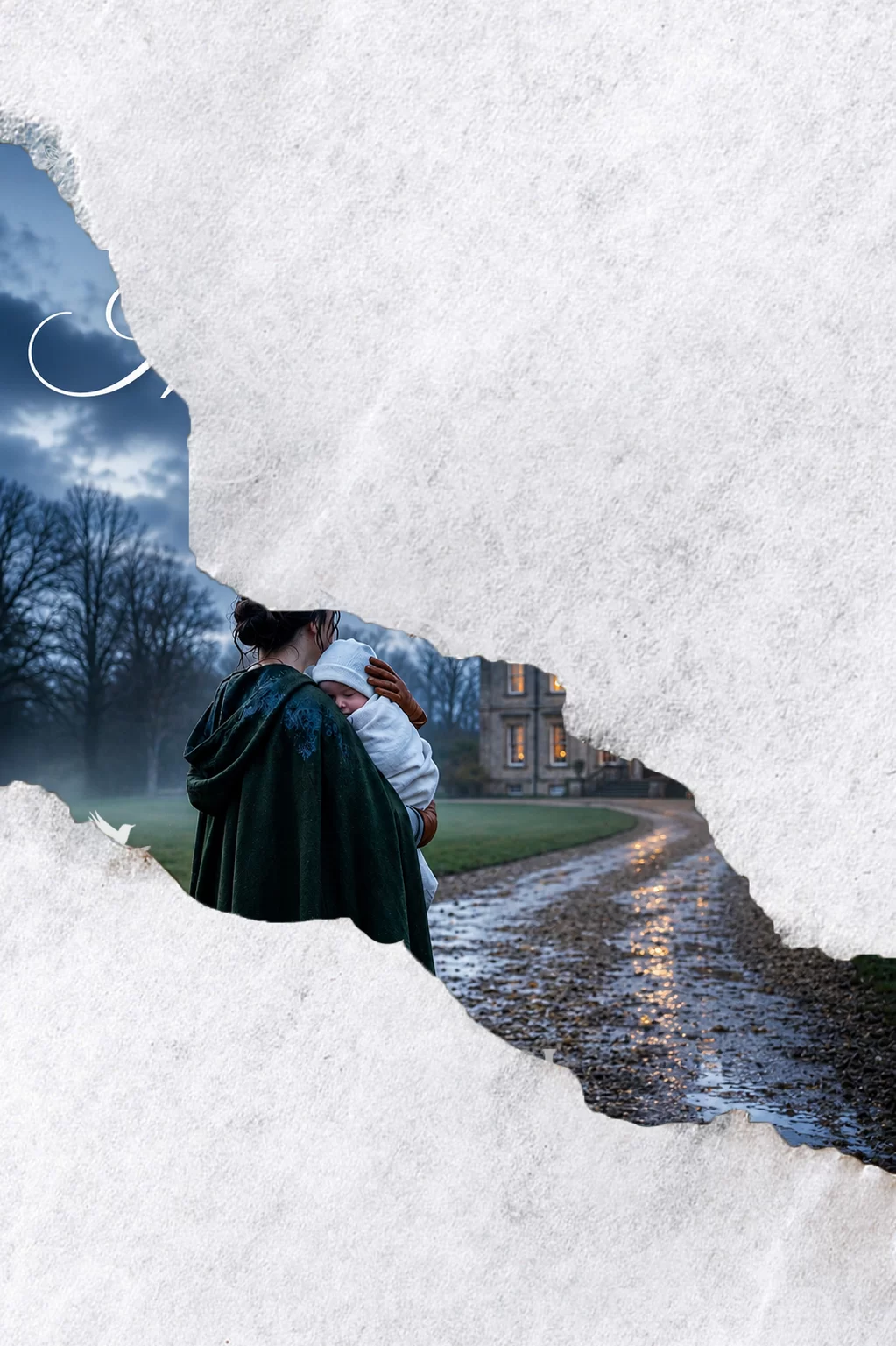
Chapter One
“Who, precisely, has brought a child to my door?”
The voice came from the top of the staircase, low and cold enough to make the candles seem to draw in their flames. It moved through the entrance hall of Ravenshaw Hall with unhurried force, gathering beneath the carved ceiling, slipping along the black oak panels, and settling over every servant like a command already obeyed.
Beatrice tightened her hold on the bundle against her breast.
The child stirred beneath the sodden edge of her cloak, his small body warm despite the rain that had soaked through wool, muslin, and every scrap of courage she had managed to preserve. She lifted her chin because lowering it would have finished her. She had spent the last two miles on foot measuring her strength in breaths, one for the road, one for the storm, one for the baby whose mouth had grown too tired to cry. She had not crossed the moor in darkness, with mud dragging at her hems and terror at her back, to stand before the Duke of Ravenshaw and look as though she had come begging.
Behind her, Martha shifted the valise to her other hand with a sound of weary outrage. “If His Grace means to judge us from that height, my lady, I should be obliged to have a chair before sentence is passed.”
Beatrice kept her eyes on the man above them. “You shall have to earn one.”
“I have walked two miles in the rain carrying everything we own. If that does not earn a chair, I cannot imagine what wickedness is required.”
“Quiet, Martha.”
“I am only observing that the hospitality so far has been vertical.”
The two footmen at the door remained rigid in their wet livery, though rain blew past them in silver gusts and spread over the marble in dark, accusing pools. On the landing, a grey-haired housekeeper clutched a candlestick with both hands, as if she had come prepared to repel thieves and had instead discovered a soaked young lady, an exhausted maid, and a furious infant.
The Duke of Ravenshaw stood above them all.
He wore a dark wool banyan over a shirt open at the throat, and the informality should have made him seem less formidable. It did not. If anything, the loosened collar and disordered black hair lent him the look of a man dragged unwillingly from some private lair, one who had been interrupted in solitude and had not yet decided whether the interruption deserved mercy. Candlelight carved his face into severe angles, catching the hard line of his cheek and the faint shadow along his jaw. He did not move at once. He looked down at Beatrice, at Martha, at the child, and at the rain spreading across his floor, with the still attention of a wolf considering how far the lamb had wandered before reaching his teeth.
Then Ned began to wail.
The cry tore through the hall, thin and furious, sharpened by hunger and cold and the indignity of being alive in a world that had already shown itself unreliable. Beatrice shifted him higher and bent her mouth to the damp edge of his cap.
“Hush, darling. We have arrived.”
Martha cast a grim glance toward the staircase. “He does not appear to share your confidence.”
“He is seven months old. He disagrees with most of creation.”
“A quality he may share with our host.”
The duke began to descend.
He came down without haste, one hand sliding along the banister, his gaze never leaving Beatrice. Every step seemed to take possession of the hall before his foot touched it. The servants watched him with the wary obedience of people who knew his temper did not require noise to be dangerous.
He stopped four paces from her.
Nearer, he was worse.
His eyes were a pale, wintry grey, steady enough to feel indecent. In a single glance, he took the measure of the mud on her boots, the torn hem of her pelisse, the missing button at her wrist, the valise in Martha’s hand, and the child hidden beneath her cloak. He looked at all of it as though each detail were a charge laid before him and he had already found her guilty.
Beatrice forced her fingers to ease before she crushed Ned’s blanket in her grip. “I am Lady Beatrice Ellingham, daughter of the Earl of Wycliffe.”
“I know who your father is.”
“Then Your Grace will understand that I would not be standing in your entrance hall at midnight unless the alternative had become impossible.”
“That is an appeal, Lady Beatrice, dressed as an explanation. I do not trade in appeals after dark.”
“Then perhaps you might trade in common shelter, since sympathy appears to be locked away with the silver.”
One of the footmen made an unfortunate sound into his fist. The housekeeper’s eyes widened. Martha, whose loyalty had never prevented her from enjoying a well-placed remark, became suddenly absorbed in the floor.
Ravenshaw’s gaze remained fixed on Beatrice.
“I do not appreciate being lectured on charity in my own hall.”
“And I do not appreciate being examined like a parcel delivered without direction. Yet here we both are, Your Grace, enduring what Providence has placed before us.”
Something changed in his face.
It was slight, almost too slight to be called an expression. One dark brow lowered by the smallest degree, and his mouth settled into a harder line. Beatrice had the unsettling impression that he had expected sobs, incoherence, perhaps a fainting fit on his marble, and had found instead a woman too wet, too tired, and too desperate to be properly afraid of him.
The discovery did not please him.
“I need to speak with you privately,” she said.
“That request is declined.”
“I beg your pardon?”
“Ladies who arrive at midnight with infants in their arms forfeited privacy somewhere along the road. Whatever you have come to say may begin with the version fit for witnesses.”
Martha shifted the valise again, and the leather handle creaked beneath the strain. Beatrice could almost hear the remarks her maid was forcing back. They would have been disloyal to the duke, loyal to sense, and impossible to survive if spoken aloud.
Beatrice drew a slow breath.
The hall smelled of rain, beeswax, old wood, and the faint iron scent of extinguished fire. Ravenshaw Hall was large enough to shelter an army and cold enough to refuse a child. The duke stood before her like the living spirit of it, all stone, shadow, and judgment.
“Then I shall have to earn your privacy back,” she said.
“You may attempt it.”
He offered neither chair nor fire nor the smallest human concession. He merely waited, and his patience pressed harder than another man’s anger.
Beatrice adjusted Ned against her shoulder. His cries had subsided into broken, miserable sounds that went through her with the cruelty of little knives.
“Might I at least have your word that the child will be warmed before I begin?”
“The child will be warmed when I have determined whether my house is being asked to shelter misfortune or conceal folly.”
“He is an infant, Your Grace. His need for warmth does not depend upon the moral quality of the adult who carried him here.”
“Everything in this house depends upon my judgment.”
“Then I pray your judgment improves quickly, for he has had a very long night.”
The housekeeper’s candlestick trembled. One of the footmen looked straight ahead with the desperate discipline of a man determined not to possess ears.
Ravenshaw came one step nearer.
Beatrice had the absurd impulse to step back. Pride held her still, though her wet slippers had begun to chill her feet and every muscle in her arms ached from the child’s weight. The duke was taller than she had thought from the staircase, broad in the shoulders, with a presence that made the hall seem narrower. There was nothing florid or theatrical in his severity. He did not bluster. He did not need to. A beast who roared might be avoided. A beast who watched so quietly made one wonder how much of the room already belonged to him.
“Take care, Lady Beatrice,” he said, his voice lowered enough that the servants had to strain to hear it. “Exhaustion may excuse a great deal, though it rarely improves a lady’s sense of self-preservation.”
Beatrice met his gaze. “If I had been concerned chiefly with self-preservation, Your Grace, I would have remained where I was.”
His eyes narrowed.
For one suspended moment, the storm outside seemed to beat more softly against the windows.
“Where were you?” he asked.
“At my father’s house.”
“That does not explain why you are now at mine.”
“No. It explains why I could not remain at his.”
Ned whimpered again, then began to cry in earnest, his little fists working blindly beneath the blanket. Beatrice tried to soothe him, but her hands had grown clumsy from cold and fatigue. The room tilted faintly. She steadied herself by sheer will and the knowledge that if she fell, someone might take the baby from her arms.
Ravenshaw noticed. Of course he noticed. A man like him would notice a crack in marble.
“Mrs. Alder,” he said without turning his head.
The housekeeper straightened at once. “Your Grace?”
“Have a fire lit in the blue chamber and send someone to wake Dr. Fenwick.”
Relief struck Beatrice so sharply that she nearly swayed again. “Thank you.”
“I have not granted you sanctuary. I have granted the child a fire and you a physician before you collapse on my floor.”
“How very generous of you to distinguish between charity and housekeeping.”
His gaze dropped to Ned, and for the first time something other than displeasure crossed his face. It was not softness. Beatrice would not have insulted either of them by calling it that. It was a brief arresting of attention, a pause so controlled that it might have passed unnoticed had she been less desperate.
“Is he yours?” Ravenshaw asked.
The question landed with the weight of everything she could not say. She could not say yes without burying Helena under a falsehood she would never retrieve. She could not say no without exposing her sister’s name to every servant in this hall.
She said nothing.
“Your silence is an answer, Lady Beatrice.”
“My silence is a protection, Your Grace. They are not the same thing, and I would ask you not to confuse the two.”
Ravenshaw watched her silence and drew his conclusion. His jaw tightened.
“I see.”
“You do not. You see what the silence allows you to assume, and the assumption is wrong.”
“Then correct it.”
“I cannot correct it without risking someone who deserves protection more than you deserve satisfaction.”
“That is remarkably forthright for a woman who has just refused to answer my question.”
“I have not refused. I have explained why I cannot comply. The distinction matters, Your Grace, even if it does not satisfy you.”
“Very little about this evening has satisfied me, Lady Beatrice, and I expect the trend will continue.”
Beatrice held the duke’s gaze. “I have walked two miles through a storm with a child who has not been properly fed since yesterday. My maid has carried everything we own in a single valise. We left my father’s house in the night, and we did not leave because the accommodations were lacking.”
“You left the Earl of Wycliffe’s household.”
“I left a house that was no longer safe for the child.”
“And you came here.”
“My sister told me to come here.”
Something changed in his face. The interrogation sharpened into genuine attention.
“Told you.”
“In a letter. The only legible line that survived the rain.”
“You have this letter.”
“I have been holding it against my body since we left the carriage, which you have already observed and which I see no reason to pretend otherwise.”
She drew it from her cloak. The paper was warped and soft, the ink bled until most of the words were gone. One line remained, stubborn and clear.
Go to Ravenshaw.
She held it out. He took it with two fingers, careful with the damaged paper, and angled it toward the nearest candle. His eyes moved across the ruined text and settled on the surviving line.
“This is not your hand.”
“No. It is my sister’s.”
“Why would Lady Helena send you to me?”
“That is a question I have been asking myself for two miles in the rain, Your Grace, and I confess I have not arrived at a satisfactory answer.”
“You expect me to supply one.”
“I expect you to consider the possibility that a woman in the final stages of a decline, who wrote your name as her last instruction had a reason for doing so, and that the reason may concern both of us.”
He set the letter down with a care that surprised her, placing it on the side table as though the damaged paper were a document he intended to preserve.
“You said the child has not been properly fed.”
“Since yesterday.”
“And you?”
“I am not the priority.”
“That was not my question.”
“It was the only answer I have.”
“It is an evasion disguised as selflessness, and I have had quite enough evasions for one evening.”
Martha said, “She has not eaten since a bread roll we split outside the village, Your Grace. If you are taking an inventory of our deprivations, I can provide a comprehensive list.”
“I do not require a list.”
Martha lowered her eyes, but the set of her mouth said the list existed and was comprehensive.
“There is something else,” Beatrice said. She reached into the folds of Ned’s shawl and withdrew the signet ring. Gold with a dark stone, heavy for its size, with a crest she had learned to recognise only after Helena’s demise, when she had found it wrapped in a handkerchief beneath a bundle of letters her sister had hidden where no one was ever meant to look. She held it out in her open palm and said nothing of the hands it had passed through to reach hers.
The reaction was immediate. Ravenshaw’s eyes went to the ring, and his mouth compressed into a line so tight his face looked as though it had been struck.
“Where did you get this?”
“From a place its owner believed was safe, hidden among letters that were never meant to be read. That is as much as I am able to tell you tonight, Your Grace.”
He did not take it from her at once. He looked at it the way a man looks at a thing he had hoped never to see again, and when at last he reached out, it was only to turn it a half circle in her palm with one finger, as though confirming a suspicion he already disliked.
“I recognise this crest as well as I recognise my own.”
“I entertained the hope that you might.” She responded weakly.
“Then you know whose hand this ring belongs on, and you know that a man like him does not part with it for sentiment or as a gift to anyone outside his own family, unless a promise has been made and an announcement is being arranged.”
“I know what the ring was meant to purchase, and I know that the purchase was never honoured, and I would rather not say the name aloud in a hall full of servants for the same reason you have gone so still at the sight of it.”
The name neither of them had spoken seemed to gather in the air between them all the same. One of the footmen’s eyes went wide. Martha’s breathing stopped and restarted. The housekeeper, halfway up the stairs, paused without turning, and the quality of her stillness suggested that the man this ring belonged to meant something in this house that went well beyond ordinary dislike.
“Adrian Voss,” Ravenshaw said, and the saying of it changed the temperature of the room.
“You have spoken his name. I notice that I did not.”
“You did not need to. You have come to my door in a storm with his ring, a child, and a letter written in a dying woman’s hand, and you have spent the quarter hour since telling me, with great precision, almost nothing. I am capable of arithmetic, Lady Beatrice.”
“Then I would ask you to be careful which figure you settle on, Your Grace, because the obvious answer and the correct one have a way of parting company, and I have given you nowhere near enough to tell which is which.”
Ravenshaw closed his hand around the ring. When he spoke, his voice had gone quiet in a way that was considerably more alarming than his earlier coldness.
“How long have you been carrying this?”
“Since we left my father’s house.”
“And the letters?”
“I could not carry everything. Martha has some. The rest are hidden where my father will not find them.”
“Your father does not know about the ring.”
“My father does not know about any of it, and I intend to keep it that way until I understand what it means and what Lord Voss proposes to do regarding the infant who is the living testament to their indiscretion.”
Ravenshaw was very still for a moment that lasted longer than the silence warranted. Then he turned.
“Mrs. Alder.”
The housekeeper descended. “Your Grace?”
“The east wing. A fire, clean linen, hot food. Send for Doctor Meade before dawn.”
“At this hour, Your Grace?”
“Did I stutter, Mrs. Alder?”
“You did not, Your Grace. I was merely observing that Doctor Meade is a man of considerable routine.”
“Then his routine is about to be disrupted. Go.”
“At once, Your Grace.”
He turned to the footmen. “You will speak of tonight to no one in this household or beyond it. Should it reach my ears that the slightest particular of this lady’s arrival has been whispered , I will identify the source, and the consequences will be swift and permanent. Am I perfectly understood?”
“Yes, Your Grace,” they said together, with the fervour of men who had just decided that a well-schooled ignorance was his greatest professional asset.
The hall emptied. Within a minute Beatrice stood alone with the Duke of Ravenshaw and a baby who had finally stopped crying.
“You will tell me everything that connects you and this child to Lord Adrian Voss.”
“I will tell you what I can. It is not the same thing, and I will not pretend otherwise.”
“You are aware that I am offering you shelter in my house.”
“I am aware.”
“And protection, such as it is, from a man whose ring you are carrying in your pocket.”
“I am aware of that as well.”
“And yet you will not tell me the full truth.”
“I will tell you the truth, Your Grace. I will simply not tell you all of it tonight, and I will not apologise for the distinction.”
“You are the most stubborn woman I have encountered in a decade of avoiding women specifically to prevent this kind of conversation.”
“Then your decade has been poorly spent, Your Grace, because stubborn women are precisely the kind you ought to have been cultivating.”
Martha, who had not left with the servants and was standing near the corridor with the valise at her feet.She maintained a steadfast silence with downcast eyes, though the strain of doing so was written plain upon her features.
“Then tell me what you can, and I will decide what is to be done.”
“And if what I tell you puts the child at risk?”
“No one is asking you to surrender him.” His voice had changed. The courtroom distance was gone. What remained was lower and plainer and harder to dismiss. “Do not mistake this house for your father’s.”
The words struck something she had been holding rigid and upright since the morning her father had looked at Ned in Martha’s arms and said send the child away, Beatrice, or I shall have it done for you. The rigidity gave way all at once. The hall tilted. The candles smeared into amber streaks.
“Martha,” she managed.
Martha was already moving, but Ravenshaw was closer. He caught her before the marble did, one arm beneath her shoulders, the other steadying Ned between them. The baby gave one startled whimper and then burrowed into Beatrice’s cloak with the logic of an infant who had found warmth and intended to keep it.
“I have her, Your Grace,” Martha said, arriving at a near-run. “If you will take the boy.”
“I have the boy. Take her other arm.”
Martha took Beatrice’s arm with the practiced steadiness of a woman who had been managing this particular person through fevers and stubbornness and grief for fourteen years and was not about to lose her now.
“Can you manage the stairs?” he asked.
“Yes, Your Grace.” She did not elaborate. She did not need to.
“The east wing. Mrs. Alder will have the room ready.”
“And the child?”
“The child stays with her.”
Beatrice tried to speak. What came out was Helena’s name, murmured once into the shoulder of a man who had no reason to hold her and had not yet let go.
Mrs. Alder appeared at the foot of the stairs, slightly breathless. “The east wing is prepared, Your Grace. The fire is lit, the bed is turned, and I have sent Thomas for the doctor.”
“Very well.”
“Shall I take the child?”
Ravenshaw looked down at Ned, who had his fist curled into the wool of the duke’s banyan and was sleeping with the ferocious determination of a baby who had decided this particular arrangement was satisfactory and would not be renegotiated.
“He appears to have made his own arrangements, Mrs. Alder.”
“So I see, Your Grace.”
“I shall carry him.”
“Very well, Your Grace. I did not presume to suggest otherwise.”
Ravenshaw looked at the maid, then at the baby, then at the unconscious woman in his arms. His carefully ordered life had, in the space of twenty minutes, been breached by a woman who had carried a baby through a storm and had not once asked for pity.
“Mrs. Alder,” he said. “Lead the way.”
“At once, Your Grace.”
“And Mrs. Alder.”
“Yes, Your Grace?”
“Send for more blankets. The child is cold.”
Martha, climbing the stairs beside him with the valise in one hand and her other gripping the banister, said quietly, “Thank you, Your Grace.”
“Do not thank me. I am merely preventing the noise from resuming.”
Martha said nothing to that. But she looked at him once, briefly, as they reached the landing, and the look contained something that a lady’s maid would never have put into words and that a duke would never have acknowledged receiving.
Chapter Two
“Where is Ned?”
Beatrice woke with the question already leaving her mouth.
For one bewildered moment, she saw only an unfamiliar ceiling and the dull glow of a fire she had not lit. Then memory returned in fragments. Rain. Marble. A man’s cold voice from above. Ned’s thin cries beneath her cloak. Her own body giving way before she could command it to remain upright.
She pushed herself up too quickly, and the room tilted. Her fingers caught at the coverlet.
“He is here, lamb.” Martha’s voice came from the chair near the hearth, tired but blessedly steady. “In the cradle, just there. Fed, warm, and asleep. You have been senseless since half past one.”
Beatrice turned at once.
Ned lay in a dark wooden cradle near the fire, wrapped in clean linen and sleeping with the solemn exhaustion of a child who had at last been permitted comfort. His cheeks had a little colour again. One small hand had worked free of the blanket and rested beside his face.
For several seconds, Beatrice could do nothing except look at him.
He was warm. He was still here. No one had taken him while she lay unconscious in a stranger’s house.
“Who fed him?” she asked.
“The physician came. Meade, his name is. An older gentleman, quiet sort. He asked after the child’s age, his feeding, and how long he had been out in the cold, then had the sense not to ask questions that were none of his concern.”
“A physician.” Beatrice looked toward the door as if scandal itself might be listening on the other side. “That is another person who knows we are here.”
Martha’s mouth pressed into a practical line. “He examined the boy, pronounced him underfed but sound, and left instructions for a pap boat with goat’s milk. Mrs. Alder had it prepared within the hour. Ned took it like a little gentleman who had waited all his life for a properly managed supper.”
“How many people in this house know I am here?”
Martha lifted one hand and began to count. “Two footmen. The housekeeper. His Grace. The physician. The cook, who supplied the milk. A scullery maid, who heated it. A stable boy, I believe, who was sent for the physician’s horse.”
“That is eight people.”
“Eight people who can place a lady and a baby under the Duke of Ravenshaw’s roof before dawn, yes. I did not choose the number, my lady. I am merely reporting it.”
“Eight is considerably more than none.”
“None left us when you knocked upon a duke’s door at midnight in a thunderstorm.”
Beatrice pressed her fingertips to her brow. Martha was right, which was often her most inconvenient quality. The moment they had crossed Ravenshaw’s threshold, secrecy had ceased to be a matter of intention. It had become a matter of luck.
Helena had exhausted her store of good fortune.
The thought came so suddenly that Beatrice had to close her eyes. She saw her sister’s face as it had been in the final week, pale and hollow and still trying to smile when Ned made his first small sound. She heard her father across the breakfast table, speaking of the child as one might speak of a misplaced parcel. Arrangements had been made. The infant would be placed with a suitable family in the north. Beatrice was not to distress herself. Beatrice was not to speak of it. Beatrice was to remember what was owed to the Ellingham name.
She lowered her hand.
“Has the duke asked for the baby?”
“No.”
“Has he asked for me?”
“Not yet.” Martha hesitated, and that small pause troubled Beatrice more than a longer explanation would have done. “He asked for the letter.”
Beatrice went still.
Helena’s letter was no longer in her possession. She had given it to Ravenshaw in the entrance hall with rain on the paper and desperation in her hands. The last thing Helena had written. The last instruction she had left. Beatrice had carried it through mud and darkness like a relic, only to place it into the keeping of a man who looked at human distress as though it were a breach of household order.
“Martha, that letter was the only piece of Helena I carried out of that house.”
“I know, my lady.”
“I gave it to a stranger.”
“You gave it to the man your sister told you to find. That may be a narrow distinction at present, but it is still a distinction.”
Beatrice accepted the cup Martha offered. The broth inside was thin and salted, and her hand shook once before she steadied it. The first swallow reminded her body that it had been asked to endure more than pride could pay for.
“Drink slowly,” Martha said. “The physician said you were nearer to a proper collapse than the sort ladies are accused of performing for attention in drawing rooms.”
“I did not faint.”
“You fell senseless in the arms of a duke. I was present. Whether we call it fainting, collapsing, or leaving the conversation with unusual drama is a question for people with leisure.”
“I prefer to think of it as a temporary loss of verticality.”
“Call it what you please. Your knees had their own opinion.”
Beatrice almost smiled. The impulse startled her. There seemed something wrong in finding humour here, in a borrowed room with Helena deceased, Ned hidden, and a duke downstairs who might yet decide that compassion did not suit the management of his house.
She drank again, more carefully.
The room was plain, though not neglected. There was a fire, clean sheets, a sturdy cradle, and a chair Martha had clearly claimed after long suffering. None of it looked welcoming by nature. It had been made serviceable because someone had ordered it to be so.
“This room is warmer than I expected,” Beatrice said.
“By command, I should think. The fire was built high, the sheets had been warmed, and Mrs. Alder brought a warming pan at three in the morning with the air of a woman who considered efficiency a moral principle.”
“She did that for a stranger.”
“She did it for the problem His Grace carried up from the entrance hall. I cannot speak to her affection, but her competence is beyond reproach.”
Beatrice’s fingers tightened around the cup. “And the duke? Has he been here?”
“He looked in once, near four.”
Beatrice went still despite herself.
“What did he want?”
“To make certain you were breathing, I suppose. He stood in the doorway, looked first at the cradle, then at you, and left again without a word.”
“That is oddly reassuring.”
“I thought so. A man who checks upon a sleeping baby at four in the morning is either very controlling or more concerned than he wishes to appear. Either way, he is paying attention.”
“Or he wished to know whether the scandal beneath his roof had survived the night.”
Martha gave her a look. “You are very determined to make the worst of him.”
“I am determined not to make the best of him too soon.”
“That may be wise. It may also be exhausting.”
“Trust has a cost, Martha.”
“So does distrust, my lady. You are too tired to be spending both.”
Beatrice looked toward the cradle. Ned slept on, safe for the moment because a man with a fearful reputation had allowed a fire to be lit, a physician to be summoned, and goat’s milk to be warmed. It was not enough to make him kind. It was enough to make him difficult to dismiss.
“What do people say of him?” she asked.
Martha’s expression changed.
“Nothing comfortable.”
“Comfort is not the first thing one expects from a duke.”
“No, though one does hope for a little of it when one has arrived at his house with a baby and no other refuge.”
“Tell me.”
Martha glanced toward the door, then lowered her voice. “They say he cuts people off without a backward glance. Relations, tenants, old friends, anyone who disappoints him. They say he can ruin a man’s credit with one letter and a lady’s prospects with one cold remark. They say he has lived away from society so long that London cannot decide whether he is mad, monstrous, or merely too proud to care what is said of him.”
Beatrice absorbed this with the unease of a woman finding a locked gate where she had hoped for a road.
Helena had sent her here.
Helena, who had trusted too easily. Helena, who had believed a man when he spoke of forever. Helena, who had passed away before Beatrice could ask why the name Ravenshaw had been left like a command at the bottom of a letter.
“And what do you say?” Beatrice asked.
“I say he carried you up the stairs with the baby still in your arms. When Mrs. Alder reached for the child, His Grace told her to leave him where he was. Then he stood there until the physician came, looking like a thundercloud that had taken human form, and every servant in the passage behaved as if the Almighty had entered the household in a temper.”
The image should not have comforted her.
It did, a little.
“That tells me he is strong,” Beatrice said. “It does not tell me he is trustworthy.”
“No. But a man who holds on when he could put you down deserves a provisional measure of credit.”
A knock struck the door.
One sharp rap, followed by silence.
Beatrice’s pulse answered before she did. There was no shuffling uncertainty in the sound, no servant’s careful deference, no polite inquiry. It had the same quality as his voice from the staircase. Possession before permission.
Martha rose. “That will be him.”
“How can you tell?”
“No servant in this household knocks as though he owns the door.”
Martha smoothed her apron, glanced at Ned, and took her place near the window with the expression of a woman who would have to be physically removed before she missed what came next.
Beatrice set the cup aside and drew herself higher against the pillows. Weakness pulled at her limbs. Pride, by long habit, took command.
“Come in.”
The Duke of Ravenshaw entered.
He was dressed now in dark wool, severe and immaculate, with a cravat tied so precisely that it seemed less a fashion than a warning. His expression had been restored to the same cold arrangement he had worn in the hall, though fatigue lingered faintly beneath it. He looked like a man who had slept little, resented the fact, and blamed the intrusion rather than the night.
He carried Helena’s letter in one hand.
His gaze went first to the cradle.
It was brief. So brief that Beatrice might have missed it had she been less desperate for any sign of what sort of man he was. Then he looked back at her, and the room seemed to settle around his authority.
“How are you feeling, Lady Beatrice?”
“I am somewhat astonished by your inquiry.”
“I am capable of courtesy.”
“You concealed it admirably last night.”
His mouth hardened by the smallest degree. “Last night you arrived at my door with a child in your arms, no proper chaperone, and a letter apparently written by a deceased woman. Under the circumstances, I considered myself restrained.”
“How fortunate for us all that Your Grace was in a temperate mood.”
Martha made a quiet sound near the window. Beatrice did not look at her. If she did, she might lose what little composure she had managed to gather.
Ravenshaw’s gaze moved briefly to Martha, who curtsied with excellent obedience and remained precisely where she was. Her posture made it plain that she intended to hear every word of the conversation unless removed by force, and perhaps even then with protest.
The duke returned his attention to Beatrice. “Since I have already admitted a physician, lit fires, and allowed a baby to sleep beneath my roof, I should like to know whether I am harbouring misfortune, scandal, or both.”
“Those are not the only possibilities.”
“In houses such as ours, Lady Beatrice, they are usually the first two to arrive. Now, I have waited until morning, which I consider generous. Begin.”
“With which part?”
“Whichever narrative casts the least shadow of suspicion upon our names.”
“They reflect no discredit upon us, Your Grace. They are facts about people who have been treated badly.”
“People become facts the moment they threaten reputations. I have lived long enough to know the speed at which the conversion occurs.”
“Then reputations are poor currency, and I am sorry for anyone who considers them the more important one.”
A muscle moved in his jaw. He looked at the letter, then at the cradle where Ned slept with his fist curled against his cheek, and then at Beatrice.
“Your sister. Lady Helena. Last night you told me she is deceased, and that it was she who sent you to my door.”
“Yes.”
“And the quarrel with your father, the one that put you on the road in a storm. Tell me how it came about.”
“Martha told me what my father intended for the child. In the hallway of my father’s house, while a dinner party continued in the room behind us.”
“You went to your father.”
“I went to my father and told him I intended to keep the child. My father told me the child was to be sent north. I told him I would not permit it. He told me that if I could not be governed I was welcome to leave his house.”
“He turned you out.”
“He gave me a choice designed to ensure I would comply. When I did not comply, the choice became a sentence.”
“And so you ran.”
“I left. There is a difference, though I grant you it looks similar when done in the middle of the night with a valise and a baby.”
Martha said, quietly, “I packed in the dark, Your Grace. In under twenty minutes, with the baby sleeping. We brought what we could carry.”
“I shall write you a letter of commendation,” Ravenshaw said.
“I would settle for breakfast, Your Grace.”
“It is being arranged.”
“Then I am content.”
Ravenshaw turned back to Beatrice with the focused attention of a man who had catalogued one piece of the story and was reaching for the next.
“The child. I asked you last night whether the boy was yours, and you did not answer.”
“I told you I could not answer safely.”
“We are no longer in a hall full of servants, Lady Beatrice. We are in a room with your maid, your baby, and a man who has already ordered a physician, a nursery, and a fire on your behalf. I believe I have earned a degree of honesty.”
“The boy is mine in every way that matters.”
“That is not an answer.”
“It is the only one I can give you, and it is true, and the fact that it does not satisfy your requirements is a limitation of your requirements, not of my honesty.”
“You are aware that evasion, repeated often enough, begins to resemble deception.”
“And you are aware, Your Grace, that pressing a woman for answers she has told you she cannot safely give begins to resemble the behaviour of the man she is trying to protect the child from.”
The words landed harder than she had intended. Ravenshaw’s expression tightened, and for one moment the controlled surface cracked and what showed through was something that was not anger and was not shame and lived somewhere between the two.
“Lord Voss,” he said, after a silence that lasted longer than either of them wanted. “The ring you showed me last night. Is Voss involved with this child?”
Beatrice went very still.
“Your face has answered before your mouth could construct a suitable evasion.”
“My face is tired, Your Grace. It is not in full command of its diplomatic faculties.”
“That much is evident. Is Voss the child’s father?”
“I cannot answer that.”
“You just did.”
“I answered nothing. You are reading conclusions into silence, which is a habit I would respectfully suggest you examine.”
“I am reading conclusions into a woman who goes white at the mention of a man’s name. That requires no particular skill of interpretation.”
Martha said, quietly, “My lady.”
“I know, Martha.”
“He is not asking to be cruel.”
“I know that as well.”
“Then perhaps he deserves a little more than you have been giving him, seeing as he has not yet thrown us out and the fire is very warm.”
Beatrice looked at her maid, and Martha looked back with the steady, unsentimental expression of a woman who had been right about enough things in fourteen years of service that her opinion had acquired the force of gravity.
“Voss is not a man to be trusted,” Ravenshaw said. His voice had gone quieter, and the quietness carried something personal. “He is not a man to be pitied, or reasoned with, or reformed by affection. Whatever promises he made, whoever he made them to, they were designed to serve his purposes and no one else’s.”
“Whatever promises he made,” Beatrice said carefully, “were not made to me.”
The pronoun landed between them, and she watched Ravenshaw register it. The word me opened a door he had not considered.
“Your sister,” he said, very slowly.
“I have learned my lesson about trusting charming men too late, Your Grace, and I have learned it on someone else’s behalf. The person who paid the price is not here to benefit from the education.”
“And the man who extracted the price? Is he likely to come looking for the evidence?”
“He is here, Your Grace. He arrived at your gates ten minutes ago, if your butler’s expression was anything to judge by.”
“He has not arrived yet. I am asking whether he is likely to.”
“Lord Voss is a man who does not leave loose threads. A child is a very conspicuous loose thread.”
“Then we are in agreement about the nature of the danger, if nothing else.”
“We are in agreement about a great many things, Your Grace. We merely disagree about how much of the truth I am obligated to provide before breakfast.”
“I must say that have learned my lesson about trusting charming men too late, Your Grace,” Beatrice said, turning back to Ravenshaw. “And I have learned it on someone else’s behalf, which is the worst way to learn anything, because the person who paid the price is not here to benefit from the education.”
Ravenshaw was quiet. The fire cracked and settled. Ned shifted in the cradle and made a small sound, and both adults turned toward it with a swiftness that would have been comical under different circumstances.
“Voss is not a man to be trusted,” Ravenshaw said. “He is not a man to be pitied, or reasoned with, or reformed by affection.”
“Whatever promises he made, they were not made to me.”
The word me sat between them, and she watched Ravenshaw register the implication. The pronoun opened a door he had not considered.
“Your sister,” he said, very slowly.
Beatrice did not confirm or deny it. She simply looked at him, and her silence this time was not evasion. It was the silence of a woman who had given him enough to see the shape of the truth and was trusting him to recognise it without requiring her to say the words aloud.
“I will not pretend to be satisfied with what you have told me,” Ravenshaw said at last. “But I will accept that you believe the concealment is necessary, and I will not press further this morning.”
“Thank you, Your Grace.”
“Do not thank me. I am merely postponing an argument I intend to win.”
“Then we shall both have something to look forward to.”
Martha looked at her sewing and said nothing, though the quality of her silence suggested she was storing observations for a later conversation that would not include the duke.
Ravenshaw turned toward the door, and it opened before he reached it.
A man stood in the doorway, thin and upright and dressed in the dark livery of a senior butler. His face was composed of angles and restraint, and his eyes took in the duke, the woman in the bed, and the baby in the cradle with a single comprehensive glance.
“Forgive the interruption, Your Grace.”
“What is it, Keene?”
“A gentleman has arrived at the outer gates. He gives his name as Lord Adrian Voss, and he claims urgent business with a Lady Beatrice Ellingham, whom he asserts is a guest of this house.”
The air in the room changed. Martha straightened from the window. Beatrice’s hand moved to the cradle and closed around the wooden edge.
Ravenshaw had gone very still.
“How long has he been at the gates?” he asked.
“Approximately ten minutes, Your Grace. He arrived in a carriage and has made no attempt to leave.”
“Did he say how he knew Lady Beatrice was here?”
“He did not, Your Grace. He said only that the matter was urgent and that he was confident you would understand the nature of his concern.”
“I understand the nature of his concern perfectly.” Ravenshaw’s voice had gone quiet in the way that Beatrice was learning to recognise as considerably more dangerous than his coldness. “Tell Lord Voss I will receive him in the formal drawing room.”
“Very well, Your Grace.”
“And Keene.”
“Your Grace?”
“No one enters this wing without my direct instruction. No one speaks to Lady Beatrice, her maid, or the child. Am I perfectly understood?”
“Perfectly, Your Grace.”
Keene withdrew and closed the door with the muted precision of a man who understood he had just delivered a lit match into a room full of tinder.
Ravenshaw looked at Beatrice. She looked back at him. Between them, Ned slept on in the cradle with his fist against his cheek.
“Stay here,” Ravenshaw said.
“He is here for me.”
“He is here for whatever he can take from you. They are not the same thing.”
“Your Grace, I will not hide in a bedroom while two men discuss my future in a drawing room.”
“You will stay in this room, Lady Beatrice, because you collapsed eight hours ago and your hands are shaking and the child needs someone beside him who is not a duke about to have a very unpleasant conversation with an old enemy.”
Martha said, “He is right, my lady.”
“I did not ask.”
“You did not need to. Please allow him to pursue his intended course.”
He turned to Beatrice. “Lock this door behind me. Do not open it for anyone whose name is not Martha, Alder, or mine.”
He left. The sound of his boots on the corridor floor grew fainter and disappeared, and the house went quiet with the particular quality of a place holding its breath before something dangerous happened in a room Beatrice could not see.
Martha crossed to the door and turned the key.
“Well,” she said. “What a fine turn of events.”
“I should scarcely have chosen that particular description myself.”
“No. You would have chosen something with more syllables and less optimism.” Martha returned to her chair and picked up her sewing as though Lord Voss were a household inconvenience rather than a threat. “But the duke has gone to meet him, my lady, and he did not go because we asked him to. He went because he wanted to.”
Beatrice looked at the locked door, and at the cradle, and at the fire that someone had built for them while she slept.
“Yes,” she said quietly. “I noticed that too.”
Chapter Three
The formal drawing room had not been used in four months, and it smelled of furniture wax and cold plaster and the particular staleness of a room that had been cleaned regularly and occupied never.
Ravenshaw stood beside the window and considered the carriage on the drive.
Seven years. He had spent seven years constructing a life in which he would never again have to look at Lord Adrian Voss’s face, and now the man was sitting in a hired carriage on his gravel at seven on the hour in the morning with the patient confidence of someone who expected to be received.
“Show him in,” he told Keene. “And see that you stay within hearing.”
“Very well, Your Grace. Shall I also send for reinforcements, or do you intend to manage this particular engagement alone?”
He shot him a glare. “That was perilously close to humour, Keene.”
“I shall endeavour to suppress it, Your Grace.”
The door opened, and Lord Adrian Voss entered the drawing room of Ravenshaw Hall as though he had been invited for breakfast.
He was precisely as Ravenshaw remembered him. Tall, fair-haired, handsome in the particular way that suggested considerable effort disguised as effortlessness. His greatcoat was damp from the rain, and he removed it with the easy movements of a man accustomed to making himself comfortable in other people’s houses. When he turned, his smile was warm and wide and as reliable as a promise written in disappearing ink.
“Magnus Harrington.” He extended his hand. “It has been too long.”
Ravenshaw did not take it. He did not acknowledge the Christian name nor his surname. He let the hand hang in the air until Voss withdrew it with a small, rueful shake of his head.
“Still the same, I see,” Voss said, settling into the chair Ravenshaw had positioned in the light. “I had hoped time might have softened you.”
“Time has done a great many things, Voss. Softening me was not among them. Why are you here?”
“I am here out of concern. Grave concern, for the welfare of a young woman who appears to have made a very rash decision.”
“Which young woman?”
“Come now, Magnus.”
“You may address me as Your Grace. You lost the privilege of my name the last time you used it to your advantage.”
The correction landed. Voss absorbed it without visible discomfort, which was precisely the problem with the man. Insults did not penetrate. Charm was the armour, and charm was flexible enough to reshape itself around any impact.
“Is Lady Beatrice Ellingham a guest of this house, Your Grace?”
“I have not confirmed that anyone by that name is under my roof, and I do not intend to confirm it on the strength of your concern, which I find implausible.”
“A lady travelling alone with a child is a delicate matter. Surely you can appreciate the urgency.”
“I appreciate that you appear to know a great deal about the child. More than a casual acquaintance of the family ought to.”
“The child is a concern to all who care for Lady Beatrice’s wellbeing.”
“And you care for her wellbeing.”
“Deeply.”
“How reassuring. And the child specifically. You mentioned the child before I did, Voss. You knew there was a child before you arrived at my gates.”
“The Earl mentioned that Lady Beatrice had taken an infant from the household. The details were not elaborated upon.”
“And yet here you are, at seven in the early hours, in the rain, pursuing details that were not elaborated upon. You will forgive me if I find your interest somewhat specific for a man acting on someone else’s behalf.”
“You were always suspicious, Your Grace.”
“I was always observant. The two are frequently confused by people who prefer not to be observed.”
Something harder surfaced in Voss’s face and vanished. A card player covering a tell.
“I did not come here to quarrel with you.”
“No. You came here to retrieve a woman and a child, and you are dressing the retrieval in the language of concern to make it palatable. I have seen this performance before, Voss. It has not aged well.”
“You are very certain of my motives for a man who claims to know nothing about the situation.”
“I am certain of your methods, which is more useful. Methods do not change. Only the targets do.”
Voss leaned forward in his chair with the practiced sincerity of a man about to say something calculated. “If Lady Beatrice is here, she is in a vulnerable position. She has left her father’s house without his consent. She is carrying a child whose circumstances are, shall we say, ambiguous. She needs someone to help her navigate the situation with discretion, and I am offering that help.”
“You are offering to manage the situation. Those are different things.”
“Are they?”
“Substantially. Help serves the person receiving it. Management serves the person providing it. You have always been more comfortable with the latter.”
“That is unfair.”
“It is accurate. Accuracy and fairness are rarely the same thing.”
“What do you want, Voss?” Ravenshaw repeated. “The real answer.”
“I want Lady Beatrice returned safely to her family. That is the whole of it.”
“That is the version you are willing to say aloud in a room where you do not control the witnesses. I have known you long enough to recognise the distance between what you say and what you want, and the distance has not shortened with the years.”
“And if I told you the truth?”
“I would be surprised. Pleasantly so, but surprised nonetheless.”
“The truth is that the Earl of Wycliffe is my friend, and his daughter has taken a child from his household, and I am here to offer my assistance.”
“The Earl of Wycliffe is not your friend. He is a man you have found useful. That is a different relationship, though I grant you the resemblance is strikingly exact.”
Voss’s smile thinned. For one moment the polished surface cracked and what showed beneath it was colder and more alert.
“You have grown unkind, Your Grace.”
“I have grown precise. Unkindness would require that I cared enough about your feelings to target them deliberately, and I assure you, I do not.”
The drawing room door opened. Beatrice walked in.
Ravenshaw went rigid. He had told her to stay in the east wing. He had told her to lock the door. He had told her in terms that could not have been plainer that Voss was dangerous, and she had disregarded every instruction and come downstairs in a borrowed dress with her rich chestnut locks pinned in wild disorder, her countenance still locked in the grey, deathly pallor of the woman who had collapsed helpless against his chest eight hours prior.
She looked at Ravenshaw first, and her chin came up in the gesture he was beginning to recognise as the one she made before doing something inadvisable.
Then she looked at Voss.
Something crossed her face in the space between one breath and the next. Fear, yes, layered beneath something harder, the way a hand remembers the shape of something it was burned by.
“Lady Beatrice.” Voss rose with fluid grace and arranged his face into gentle relief. “My dear Lady Beatrice, you have frightened everyone half to death. Your father has been beside himself.”
“Not everyone, my lord. Some people appear quite alive to advantage.”
Ravenshaw, from the window, said quietly, “Careful, Voss. She has teeth.”
Voss glanced at him. Something complicated moved behind the warmth.
“I am so pleased to find you safe,” Voss said, turning back to Beatrice. “Your father will be enormously relieved. I have a carriage on the drive, and if you will allow me, I can have you home by evening.”
“I will not be going home, my lord.”
“Lady Beatrice, I understand that families can be difficult, and that disagreements sometimes produce rash actions that feel necessary in the moment…”
“I did not ask for your understanding of my family, Lord Voss. I did not ask for your carriage, or your escort, or your interpretation of my actions as rash.”
“You are very young, Lady Beatrice.”
“I am twenty years of age, old enough to recognise condescension when it is dressed as concern.”
“Surely old friends may be permitted one small intervention.”
“Old friends, perhaps. And what are we, my lord?”
“I had hoped we were acquaintances who wished each other well.”
“Then you may wish me well from a distance. I find the arrangement suits me better.”
Voss turned to Ravenshaw. “Your Grace, you must see that the lady is distressed. A woman in her condition, making decisions of this magnitude without the counsel of her family…”
“Her condition,” Ravenshaw repeated.
“I mean only that she has been travelling under difficult circumstances.”
“Her circumstances became difficult when she was given reason to flee her father’s house in the middle of the night, Voss. The travelling was a consequence, not a cause. I would prefer you not to confuse the two in my drawing room.”
Beatrice looked at Ravenshaw with an expression he could not entirely read. Surprise, perhaps. Or the beginning of something adjacent to trust, caught before it could fully form.
“Lady Beatrice can speak for herself,” she said. “She has been doing so since she arrived, and she does not require either of you to narrate her condition on her behalf.”
“Noted,” Ravenshaw said.
“Noted and appreciated are different things, Your Grace.”
“I am aware of the distinction. I employ it frequently.”
Voss’s smile had gone thin and watchful, and Ravenshaw could see him recalculating the geometry of the room. This was not the situation he had anticipated. He had expected a frightened woman alone in a strange house, desperate for rescue. He had found a frightened woman who had already made an ally of the house’s owner and had no intention of being rescued by anyone.
“The child,” Voss said, and the word was placed with the precision of a knife on a tablecloth, soft and deliberate. “A woman travelling alone through the night with a child invites questions, my lady. Questions that, once asked, are very difficult to un-ask. I should be vastly sorry to see your reputation pay the forfeit for a decision made whilst your mind was so severely tried.”
“And I should be vastly sorry to see anyone’s reputation suffer for decisions made by men who were not present for the consequences. We all have our hopes, Lord Voss.”
“This is not a matter of hopes. It is a matter of fact. People will talk.”
“People will always talk, my lord. The question is whether anyone worth listening to is among them.”
Beatrice went pale as she said it, and Ravenshaw watched the bravado hold for exactly as long as the words required and then begin to crack at the edges. She was terrified, and she was performing courage, and the performance was good enough to fool Voss but not quite good enough to fool a man who had caught her when she collapsed eight hours ago and had felt how thin she was beneath the cloak.
The pattern was unmistakable. Charm first, then concern, then the carefully placed threat disguised as solicitude. Ravenshaw had watched Voss perform this sequence once before, in a different drawing room, with a different woman, and he had not understood what he was watching until the damage was done.
“They may ask me,” Ravenshaw said.
Voss turned. Beatrice turned. The room went still.
“I beg your pardon?” Voss said.
“You expressed concern that questions might be asked about Lady Beatrice’s reputation. You may direct anyone with such questions to me.” He stepped forward from the window. “Lady Beatrice is my betrothed. The banns will be read at the earliest opportunity. Any enquiry into her conduct, her character, or the child in her care is an enquiry directed at the future Duchess of Ravenshaw, and I will treat it accordingly.”
The silence that followed was long enough for Ravenshaw to hear the rain against the windows and the distant creak of a floorboard in the corridor where Keene was presumably listening.
Voss recovered first. The smile returned, narrower and more deliberate.
“My congratulations, Your Grace. I had no idea the attachment was so advanced.”
“It is advanced enough.”
“And Lady Beatrice’s father? Has the Earl given his blessing?”
“The Earl will be informed. His blessing is not required.”
“How very resolute, and exceedingly swift.”
“I have found that rapidity is advisable when dealing with threats that present themselves as concern.”
“I meant no threat.”
“You never do, Voss. That has always been your particular talent.”
Voss turned to Beatrice, who was standing behind the nearest chair with her face white and her eyes wide and her mouth set in a line that Ravenshaw could not read as fury or gratitude and suspected was both.
“My felicitations, Lady Beatrice. I hope the match brings you everything you deserve.”
“Thank you, Lord Voss. I hope the road home is not too muddy.”
“I wonder, though.” Voss reached for his greatcoat and drew it on with the same unhurried ease with which he had removed it. “You have chosen a very powerful protector. His Grace is nothing if not formidable. But one does wonder whether a woman who arrives at a gentleman’s door in the middle of the night and emerges the next morning as his betrothed has been rescued, or merely acquired.”
“That is enough,” Ravenshaw said.
“I mean no offence.”
“You mean precisely the offence you have calculated, delivered with precisely enough deniability to retreat behind if challenged. I have watched you do this before, Voss. There is, most regrettably, no amendment to be seen in the arrangement of the steps.”
Voss held his gaze for a long, measured moment. What passed between them was older than this morning and older than this woman. It lived in the space between two men who had once been friends and were now something considerably worse. The betrayal that had ended the friendship had never been acknowledged by the man who committed it and never been forgotten by the man who survived it.
“Then I shall take my leave,” Voss said. He bowed to Beatrice. At the door he paused.
“You will discover, my lady, that His Grace shelters nothing he does not first intend to own.”
The door closed. The carriage wheels ground against the wet gravel and faded.
Beatrice released the chair.
“Your betrothed,” she said, and the words came out flat and vibrating with a fury that Ravenshaw had not anticipated and should have.
“Yes.”
“You announced my future to that man as though you were ordering a change to the dinner service.”
“I announced the only version of your future that does not end with you destroyed by morning.”
“You did not ask me.”
“There was no time to ask you.”
“There is always time to ask, Your Grace. You simply chose not to take it.”
“If I had taken it, Voss would have taken the opening. I have seen him build before, and I have seen what the structure looks like when it is complete, and I was not prepared to watch him build it around you.”
“So instead you built it yourself. You decided my future without consulting me, which is exactly what my father did, and what Lord Voss did to my sister, and I am beginning to wonder whether every man I encounter believes the appropriate response to a woman in difficulty is to make her decisions and expect her gratitude.”
The accusation landed with more precision than he had braced for. She was right, and the fact that she was right did not make the betrothal wrong. It merely made the method indefensible.
“I am not your father,” he said.
“No. You are a man I met twelve hours ago who has just announced to my worst enemy that I am to be his wife. You will forgive me if the distinction feels somewhat academic at this moment.”
“It is not academic. Your father acted to protect his reputation. I acted to protect you.”
“And yourself.”
“Yes. And myself. I will not pretend otherwise.”
“That is the first honest thing you have said to me since I arrived.”
“It is not. I have been honest throughout. You have simply been too busy surviving to notice.”
Her eyes locked with his in a silent, unwavering regard, to which he returned a look of equal intensity, whilst the persistent patter of the rain beat a soft cadence against the windowpanes.
“You could have warned me,” she said, and something in her voice had shifted away from fury toward something quieter and more bruised. “You could have found thirty seconds to tell me what you intended to do. I would have agreed, Your Grace. That is the part that should concern you. I would have agreed, and you did not give me the chance.”
That landed worse than the accusation. The reason he had not asked was simpler and uglier than the excuse of insufficient time. He had seen the threat and he had moved, and the woman the threat was aimed at had been, in that moment, a problem to solve. He had not thought to consult her. The omission had been instinctive, and the instinct was not one he was proud of.
He did not know how to say that without making it worse.
“After breakfast,” he said. “We will discuss every term. You will have conditions, and I will hear them.”
“I will have conditions, Your Grace, and you will meet them, or there will be no betrothal for Lord Voss or anyone else to speculate about.”
“I have no doubt.”
“You should have some doubt. Doubt would be appropriate.”
“I have doubt about a great many things, Lady Beatrice. Your capacity for conditions is not among them.”
She looked at him, and he looked at her, and the space between them held more competing furies than the room had been designed to contain.
“After breakfast,” she said.
“After breakfast.”
“And it had better be a substantial breakfast, Your Grace, because I have not eaten properly in three days and I do not negotiate well on an empty stomach.”
“I will inform Mrs. Alder.”
“Do. And tell her I require toast. And eggs. And whatever else this mausoleum passes off as hospitality.”
“Mausoleum.”
“It is a very handsome house, Your Grace, but the temperature suggests the occupants may not all be living.”
“The occupants manage adequately.”
“The occupants manage, Your Grace. Whether they do so adequately is a question I shall reserve judgement on until I have been fed.”
She turned and walked out of the drawing room with her borrowed skirt whispering against the floor and her spine as straight as anything he had ever seen.
Ravenshaw stood alone in the cold room and listened to the rain.
He had spent seven years perfecting the art of not caring. He had refined it into a discipline, a practice, a way of moving through the world that permitted no attachment and tolerated no vulnerability, and a woman he had met twelve hours ago had walked through his front door and dismantled the entire architecture in the time it took to collapse into his arms.
He thought about Voss’s face when the betrothal had landed. The brief flash of calculation behind the smile. He thought about Beatrice’s face when she turned to him afterward, the fury and the fear tangled so tightly that separating them would have required a steadier hand than his.
Mrs. Alder appeared in the corridor. “Your Grace, shall I prepare the library for Lady Beatrice’s breakfast, or would you prefer the morning room?”
“The library. It has a better fire.”
“Very well. And the child? Shall I send someone to relieve the maid?”
“No. The maid stays with the baby. She has earned the right.”
“If Your Grace will permit the observation, the maid has opinions.”
“I had noticed.”
“Strong opinions, Your Grace. About a great many things, delivered with a frequency that suggests she does not consider silence a virtue.”
“I had noticed that as well, Mrs. Alder.”
“Very well, Your Grace. I merely wished to ensure you were prepared.”
“I am prepared for a great deal, Mrs. Alder. Whether I am prepared for this particular household configuration remains to be seen.”
“If it is any comfort, Your Grace, the young lady appears to be precisely as stubborn as you are, which suggests either a very effective partnership or a very spectacular disaster.”
“Thank you, Mrs. Alder. That is not, in fact, a comfort.”
“No, Your Grace. I did not suppose it would be.”
She withdrew, and Ravenshaw stood in the empty drawing room and looked at the chair where Voss had sat. The cushion was still slightly depressed. The man had been in this room for less than twenty minutes, and in those twenty minutes Ravenshaw had announced a betrothal he had not planned, acquired a wife he had not sought, and committed himself to the protection of a child whose father was the one man in England he had spent seven years avoiding.
Keene appeared in the doorway.
“Shall I inform Mrs. Alder about the breakfast, Your Grace?”
“Mrs. Alder has already been informed. She anticipated the requirement, as she anticipates most things.”
“Very well. I shall also see that the formal dining service is prepared for future use. Based on the volume of the conversation I overheard through the door, a larger table may provide a tactically advisable distance between Your Grace and the future Duchess.”
“You were listening.”
“I was within earshot, Your Grace. As instructed.”
“And your assessment?”
Keene paused. “Of Lord Voss, Your Grace, or of the lady?”
“Both.”
“Lord Voss smiled a great deal, Your Grace. In my experience, men who smile that frequently in uncomfortable situations are either saints or confidence tricksters, and I have yet to encounter a saint who arrived in a hired carriage at seven in the morning.”
“And Lady Beatrice?”
“She has teeth, Your Grace.”
“So I have observed.”
“And she appears to be under the impression that she is going to negotiate terms with you over breakfast.”
“She is.”
“Then I would suggest, Your Grace that you eat before she arrives. It is difficult to negotiate effectively when one is distracted by toast, and the lady does not strike me as someone who will allow distraction to work in your favour.”
Ravenshaw looked at his butler and saw, beneath the formal composure, something that might have been amusement.
“Thank you, Keene.”
“Always a pleasure, Your Grace.”
“That is debatable.”
“Most good counsel is, Your Grace. Most good counsel is.”