
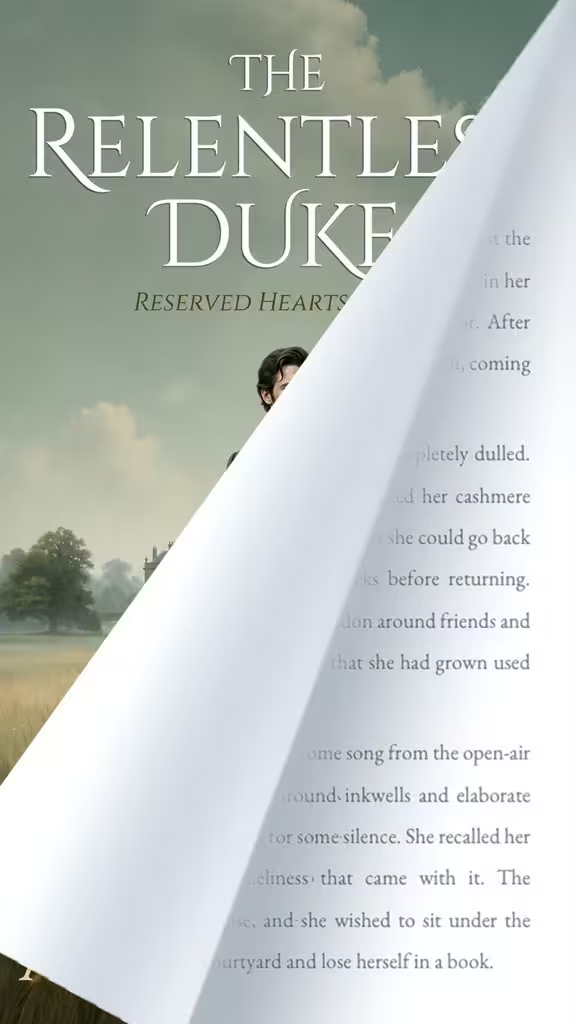
Chapter One
“If I were you, I would make him regret every word he has ever spoken.”
Lucy Fairbourne watched the dancers turn beneath the chandeliers and let the potted orange tree hide as much of her as a potted orange tree could reasonably be asked to hide.
“If you were me, you would last ten minutes before being banished from respectable society,” Lucy said wryly, and kept her eyes on the dancers, and did not once look where her cousin was looking.
“Then make them useful ten minutes.” Marianne snapped her fan shut. “He is not even ashamed. There he stands with Miss Leighton on his arm as though he never once sat in your father’s drawing room.”
Lucy smoothed a glove that had no crease in it. “I would rather not discuss Mr. Ashwick in a room full of feathers.”
“You would rather not discuss anything at all. That is the whole difficulty with you.”
“He courted me for three months, Marianne. I did not imagine that.”
Marianne’s hand closed over hers. “Of course you did not imagine it.”
Lucy drew her hand back and folded it with the other. “He told a card room full of gentlemen that I mistook ordinary courtesy for devotion. I have had the phrase repeated back to me by four separate people who each believed they were being kind.”
“And Miss Leighton believes every word of it, I suppose?”
“Miss Leighton believes he is charming, and rich enough to be forgiven anything. She has forty thousand pounds, and her father wants the barony that is coming to him. His uncle is Lord Ashwick, and Lord Ashwick is one and sixty and childless and disobliging enough to live forever, but he will not live forever, and Julian will be a baron before he is forty. That is what Lord Leighton is buying.” Marianne snapped her fan open again. “She will not trouble herself over whether I imagined a courtship.”
“Forty thousand pounds buys a great deal of not troubling oneself.”
“It buys everything.” Lucy turned her fan over in her lap and did not open it. “You may stop looking at me as though I am about to shatter. I have been shattered for three weeks. I have grown accustomed to the arrangement of the pieces.”
“Then let us give the ballroom something else to repeat.” Marianne turned so sharply that a passing footman adjusted his tray. “Look discreetly towards the far doors, do you observe that gentleman of notable height with his dark hair and piercing grey eyes?” Lucy turned towards the doors.
“The gentleman in black attire, who has declined to dance with a single person all evening.”
“I see him. He looks as though someone brought him here against his will and he intends to make them regret it.”
“That is the Duke of Wycliffe. Godfrey Sotherton.” Marianne dropped her voice to the register reserved for scandal. “They say he ruined a baron over cards and did not trouble to look pleased about it. They say a woman once fainted merely from being introduced to him.”
“They say a great many foolish things at these affairs.” She looked at him again all the same, and then away, and then, briefly, back.
“I dare you to win his notice. One turn about the room on the arm of the most dangerous man in London, and Julian Ashwick will remember precisely what he threw away.”
“Absolutely not.”
“Lucy, it is but a small, innocent dare. I did not ask you to steal a kiss from him, though…”
Lucy snapped her own fan open at last and used it, though the room was not warm. “I have already been made a spectacle once this Season. I have no intention of volunteering for a second engagement.”
“You are not a spectacle. You are a girl who was deceived by a coward, and the difference matters even if no one in this room can be troubled to see it.”
“The difference does not matter to anyone but you. He said it in a card room, confidently, and I said nothing at all, and that is how such things are decided.”
“Then be clever back at him.”
“I have not the stomach for it tonight.” She touched the rim of a waxy leaf as if she had come only to admire the tree. “Perhaps tomorrow, when I am less inclined to weep in a potted plant.”
She meant it, and she kept to the plan right up until two gentlemen paused on the far side of the orange tree and one of them laughed in a voice she would have known anywhere.
“Miss Fairbourne is a sweet creature,” Julian said, “but some ladies mistake ordinary courtesy for devotion. One cannot be forever answering for another person’s imagination.”
The gentleman beside him murmured something Lucy did not catch. Julian laughed again, easy and unbothered. It had cost him nothing at all to say, and it would cost him nothing to say again.
“Lucy,” Marianne said, reaching for her hand. “Do not listen to him.”
“I need air.”
“Let me come with you.”
“No. I need one room in this house where nobody is deciding what I imagined.” She pressed her cousin’s fingers once and released them. “Stay. Enjoy the feathers.”
She would not run, for swiftness would betray her, and to betray her presence was the fatal error she dared not commit. She walked instead, unhurried, looking at nobody, until she reached a door standing ajar on a room too dark to be part of the evening’s plans. The library took her in and shut the evening out behind her. One lamp burned low on a side table, and the fire had settled to a red and companionable glow. She leaned her spine against the shelves and let her face do, finally, whatever it wished to do.
“You are either hiding from someone, Miss Fairbourne, or waiting to ambush him.”
She was not, it turned out, alone.
The Duke of Wycliffe sat in a wing chair angled towards the fire, a glass of brandy on the arm and a book across his knee that he had plainly not been reading.
She had a hand flat against the shelf behind her and took it away. “Your Grace. I did not see you.”
“Few people do, when I take the trouble not to be seen. It is one of my more useful accomplishments.”
“I was told you were dangerous. Nobody mentioned you were furniture.”
Something moved at the corner of his mouth that shared a border with a smile. “Can a lady not simply wish to look at books?” he asked.
“I beg your pardon?”
“That is what you were about to tell me. That you came here to admire the shelves.” He lifted his glass a careful inch. “It is a transparent falsehood, at best. Not at midnight. Not while breathing as though you have just escaped a duel.”
“I am not hiding.”
“No?”
“I am merely appraising the room, I assure you.”
He moved the book off his knee to the table without marking his place. “Then sit, and appraise. The chair opposite has an excellent view of the door, which I gather is the direction from which your trouble usually arrives.”
She sat, without quite knowing why, except that the alternative was a ballroom deciding what she had imagined, and this dark quiet man had decided nothing about her at all.
“You are trembling,” he said. “Not from cold. The fire is more than adequate to the room.”
“I am not accustomed to being alone with dukes in dark libraries.” Her hands went quiet in her lap, which took some doing.
“You are not trembling because of me. You had the look before you saw me. Someone beyond that door has spent the evening taking small bites out of you, and you have been very brave about pretending not to bleed.”
“That is a remarkably grim way to describe a ball.”
“I attend balls enough. I have never once found a truer description of one.”
She looked at the book lying open on his knee. “What were you reading?”
“Nothing. I find a book the most reliable way to be left alone in a crowd. One holds it open, looks displeased, and society obligingly does the rest.”
“You have made a philosophy of being disliked.”
“I have made a fortress of it. There is a difference, though few take the trouble to notice.”
“You know who I am,” she said.
“Everyone at this party knows who you are. That is rather the source of your difficulty.”
“You do not waste breath on idle flatteries, I see.”
He turned the brandy a half circle on the arm of the chair and did not drink it. “I am very tired. Being candid is what remains after a man has spent two hours listening to Ashwick be charming.”
“You know Mr. Ashwick?”
“I know men like Mr. Ashwick. He is not as original as he believes.” The duke studied her over the rim of his glass with an attention that felt less like flirtation than like arithmetic. “He has made you look foolish because he is too cowardly to look dishonourable. It is the commonest trade in London. Barter another person’s dignity for your own comfort, and be sure to smile while you do it, so that anyone who objects appears unreasonable.”
“You know nothing of it.” She had risen an inch out of the chair before she noticed she was doing it, and sat back down.
“I know cowards. They are tedious, but they are rarely inventive.” He tilted his head a degree. “Yours will use the same phrase for years, because it worked once and thinking of a second would be effort. Which phrase is it?”
“I do not see why I should tell you.”
“You should not. You will anyway, because you have been carrying it about all evening looking for somewhere to set it down, and I am, whatever else I am, extremely safe. I do not indulge in idle scandal. It would require me to converse with people I dislike.”
Lucy looked at the fire, weary past bearing of holding the thing alone. “He says I mistook ordinary courtesy for devotion.”
“Ah.”
“He does it gently, so that everyone believes he is sparing my feelings, when what he is doing is making certain I can never say a true word against him without sounding bitter, and imaginative, and greedy for a courtship I invented out of a few pleasant afternoons.”
“Yes. That is precisely what he is doing, and he is rather good at it. He would be less good at it if you would stop being ashamed and start being angry, but shame is warmer and easier to wear, so most people never make the exchange.”
“You speak as though you have made it yourself.”
“I made it a long time ago, and I have never once regretted the warmth I gave up for it.” He turned the glass slowly by its stem. “What is your Christian name?”
“Lucy.”
“Lucy.” He said it as though testing whether it would bear weight. “It is a poor fit for a wallflower.”
“I was not always a wallflower.” The fire put a log down into itself and she watched it do so rather than look at him. “The condition is recent, and I am told incurable.”
“Most conditions are curable with sufficient rudeness. You are speaking to living proof.”
“And what is it you are so tired of tonight, Your Grace, which causes you to hide in a library of your own?”
“The same thing you are. A room full of people performing sincerity. Yours performs pity. Mine performs admiration. Neither is worth the candles they burn to light it.”
“You make excellent company for a man who claims to prefer none.”
“I prefer good company. It is merely so rare that I have learned to travel without it.”
“That is either very sad or very arrogant. I have not yet decided which.”
“It is both. The two are frequently the same coat turned inside out.”
“Why are you telling me any of this?” The question came out sharper than she had meant it, and she did not soften it. “You do not know me at all.”
“Precisely because I do not know you. By tomorrow you will be a story someone tells at breakfast, and I will be a story someone tells at breakfast, and neither of us will ever be obliged to be honest with the other again. Tonight is the only safe hour the two of us shall ever have, and it seems a waste to spend it being untruthful.”
“You are a very strange man, Your Grace.”
“So I am reliably informed. I have stopped taking it as an insult and started taking it as a description.”
“You are laughing at me,” she said.
“I am laughing near you. It is a different thing, and a rarer one.” He said the rest of it to the fire irons. “I have not done it in company for longer than I care to admit to a stranger in a borrowed library.”
“Then either I am very amusing, or you keep very poor company.”
“Both, I begin to suspect, though only one of the two failings is your doing.”
“You have not once asked me about Mr. Ashwick,” she said. Her thumb had found the seam of her glove and was working at it. “Everyone asks. They arrange their faces into concern and mean appetite.”
“I have no appetite for Ashwick. I have watched him at cards. A man who shaves the odds at whist for stakes he can well afford will do worse for the stakes he cannot, and there is nothing left in him worth the asking. The whole of the man is written face up on the table.”
She looked up, past the dark hair shadowing his brow and directly into his piercing grey eyes. The ballroom had missed the more interesting thing about the Duke of Wycliffe entirely. They called him cold and they were wrong. He was banked, like the fire at his elbow, giving off far more heat than the low flame promised anyone unwilling to sit close enough to feel it.
“You are not what they say you are,” she said.
“I am considerably worse. They merely lack the imagination to guess the details.” He set the glass aside. “Tell me the truth, since we are being honest. When Ashwick stood on the far side of that shrubbery and said his charming little sentence, what did you wish to do to him?”
“Nothing a lady may admit to in company.”
“We are not in company. That is the entire charm of a dark library.”
Her hands tightened in her lap. “Then I wished to make him feel, for one single hour, precisely as small as he has made me feel for three whole weeks.”
“That is not so difficult as you imagine. Small men are easily reminded of their size. It wants only someone unafraid to do the reminding.”
“And you are unafraid?”
“I am bored, which serves the same purpose and lasts a good deal longer.” He watched her for a moment. “You still have not told me what brought you to my library. Not the shelves. Not the air. The truth this time, for the novelty of it.”
“My cousin dared me to ask you for a kiss.”
The fire ticked into the silence, and somewhere beyond the door a violin found the end of a set.
“Your cousin is either very foolish or very perceptive,” the duke said.
“Which?”
He did not take his eyes from the fire. “That depends entirely on whether you intended to win.”
Heat climbed her throat, washing up towards the sweep of her auburn hair, and she was grateful for the low light, though it did nothing to hide the sudden warmth in her amber eyes. “I intended no such thing. I intended to refuse her, and I did refuse her, and then Mr. Ashwick opened his mouth on the other side of a shrubbery and I stopped intending anything sensible at all.”
“A pity. I should have enjoyed watching you try to win. You do not lose gracefully. It is written all over you.”
“I lose very gracefully. I have had practice enough at it this Season.”
“That is not losing, Miss Fairbourne. That is being robbed and thanked for the convenience. The two are easily confused, but they are not the same.”
The duke rose from the chair without hurry and crossed the small distance between them, stopping an arm’s length away, close enough that she had to lift her chin to hold his gaze and not one inch closer. He did not touch her. He did not so much as reach.
“A dare is a dangerous game to play with a man like me, Miss Fairbourne. You will find I always collect.”
She did not step back, though her heel had found the shelf behind her. “And if the lady has changed her mind?”
“Then the lady keeps her kiss, and I keep my disappointment, and we agree the debt stands open. I am a patient creditor. It is nearly my only virtue.”
“You speak of a kiss as though it were an account at your bank.”
“Most things are an account at somebody’s bank. I merely have the poor manners to say so aloud.”
“And what interest would you charge on such a debt?”
“That would depend entirely upon the borrower.” He looked at her a moment longer than was strictly decent. “You are not frightened of me. I confess I find it novel.”
“I have been frightened of several things tonight, Your Grace.” She tipped her chin up the last half inch it had left to give. “You are, at present, the least of them.”
“You wound me. I have worked years for my reputation.”
“Then you have been badly served by it, because it did not survive five minutes of your own conversation.”
Which was the moment the library door swung wide.
Lamplight spilled in from the corridor with the noise of the ball. Julian Ashwick stood framed in the doorway with three curious guests ranged behind him, wearing an expression of such immaculate concern that she understood at once. He had followed her and waited, and the open door and the arranged witnesses had been the plan from the very start.
“Miss Fairbourne,” Julian said, warm with false alarm. “Your family has been searching everywhere for you.”
Nobody in the doorway moved, and behind Julian a woman in grey lifted her fan and murmured to her neighbour, and the murmuring had already begun. Alone at midnight in a dark room with the Duke of Wycliffe near enough to touch, and the last three weeks folded up small and cold inside Lucy’s chest, because there was no version of the story that saved her now.
Then the duke stepped, unhurried, to her side.
He did not take her arm, because he did not need to. He placed himself beside her so that any account of the room now had to be an account of them both, and when he spoke he spoke to Julian with a mild and lethal courtesy, having already decided the outcome and being content to wait for everyone else to catch up.
“Excellent,” said the Duke of Wycliffe. “Then you may tell them they have found the future Duchess of Wycliffe.”
Julian’s mouth opened and produced nothing at all for the length of a breath. “Wycliffe. You cannot be serious.”
“I am almost never serious, Ashwick. This is one of the rare occasions, and I recommend you enjoy it, since I do not expect to repeat myself.” Godfrey inclined his head a precise degree towards the swan-masked woman and her busy fan. “You will want to be first with the news. I should hate to deprive you of the pleasure.”
Lucy turned to look at him. The words came slowly, one at a time, arriving long after the ground beneath her had gone, and she stood in the ruin of her careful forgettable plan and understood, far too late to do anything about it, that the most dangerous man in London had just announced a betrothal she had never once agreed to.
Chapter Two
“You cannot say such things.” Lucy’s voice scarcely carried past his shoulder.
“I can. I am a duke. Society has trained me badly.” Godfrey kept his voice at its ordinary pitch, because a murmur now would be taken for a secret, and a secret was the one thing this room must not be handed to chew.
Beyond the door, the silent tally of consequences had already begun. Lady Haverford stood near the card-room arch, bright and fixed, calculating how far a story would travel by morning and whether it would improve her invitations, and Ashwick had gone white about the mouth, watching his own clever plan turn in his hand and open a vein.
That last was very nearly worth the whole tedious evening.
Julian had staged the thing badly. The open door, the guests ranged behind him, the practised alarm in the voice. He had rehearsed his triumph in a glass and never once considered that the room might be handed to somebody else. He had meant to ruin the girl and had succeeded only in delivering her, a gift beyond price, to the one person at the ball with rank enough to make the ruin vanish.
And the girl was frightened. That was the part Godfrey had not planned for and did not care to examine. She stood very straight and very pale, holding her own hands as though they might otherwise misbehave, and the sight of it sat wrong in a way he had spent ten years arranging his life to avoid.
“Come,” he said, offering his arm. “We are quitting this doorway before anyone recovers enough to frame a question.”
She did not take the arm, but she walked, which served as well. The corridor beyond swallowed the light and most of the noise, and the moment the ballroom fell behind them she came back to life all at once.
“You have attached your name to mine without permission.” She was walking faster than he was and did not slow for him.
“And saved yours from being dragged through every drawing room in London by breakfast.”
“That does not make you noble.”
“No. Merely efficient.”
She stopped walking. “Why would you do such a thing? You do not know me.”
“I know Ashwick. On some evenings that proves sufficient.”
“That is no reason to enter into matrimony with a stranger.”
“It is a reason to stop a man I dislike from winning. The matrimony is only the most efficient weapon to hand, and you are the person it also happens to rescue.”
“You are very cold about it.”
“I am very honest about it. In time you will come to prefer the one to the other, though I grant the preference takes some acquiring.” He slowed his pace to hers, which cost him something, since his instinct in a crisis was to move quickly and let the world hurry after. “You may be as angry with me as you like. I would only ask you to be angry quietly until we reach your family, because a duchess who shouts in a corridor makes a far better story than a duchess who was merely caught reading.”
“I am not your duchess.” She said it to the wall sconces and not to him.
“Not yet. You are at present the subject of a rumour that will settle the question for you unless someone with more standing than Ashwick settles it first.”
“And that someone is you.”
“Regrettably. I did look about for a better candidate. The corridor was empty.”
“Do you make a habit of proposing to women you discover in libraries?”
“You are the first. I dislike libraries at parties. They are the room people retreat to when they wish to be sincere, and sincerity at a party is almost always a trap. I ought to have known better than to sit in one.”
“And yet you sat.”
“And yet I sat. I begin to suspect the entire evening arranged itself around my single lapse of judgement.”
She almost smiled at that, and stopped herself, which he found he minded. Girls in this position wept, in his limited and carefully guarded experience, and weeping he could have managed with the cool competence he brought to every unpleasant necessity. Instead she argued, and turned each of his answers over in search of its weakness, and it interested him a good deal more than the situation warranted.
“Where are your people?” he asked.
“By the refreshment room. My father and my aunt.” She stopped, taking longer than necessary to push a stray pin back into the thick, auburn waves of her hair. “And my cousin, who is about to learn what a dare costs.”
***
They found Mr. Fairbourne near the refreshment room with Mrs. Selwyn at his elbow and Marianne hovering white-faced behind them both. One glance at Lucy’s countenance and the duke at her shoulder, and Fairbourne’s colour drained to match his daughter’s.
“Lucy.” Her father set down his glass with a hand that had stopped being steady. “Tell me you have not done a thing we cannot mend.”
Godfrey took the glass out of the older man’s hand and set it back on the table. “She has done nothing, Mr. Fairbourne. That is precisely the difficulty. Nothing whatever has been done, and by morning all London will be certain a great deal was.”
“It was my doing.” Marianne’s words tumbled out ahead of her courage. “I dared her. She would not, and I pressed her, and it is my fault entirely that she went anywhere near that library.”
“Then she is betrothed to a duke, which is a good deal further than most dares carry a girl.” Godfrey inclined his head towards Marianne with grave courtesy. “You have my thanks. I could not have arranged a more useful evening had I planned it, and I assure you I did not.”
“Useful,” Fairbourne said, and the word came out with no strength in it. “My daughter’s name is on the tongue of every busybody in this place, and you call it useful.”
“Her name was going into their mouths regardless, Mr. Fairbourne. My only alteration was the manner of it. A ruined Miss Fairbourne is a tragedy anyone may repeat at leisure. A betrothed Duchess of Wycliffe is a triumph they will resent too much to enjoy. I have merely changed the flavor of the gossip from pity to envy, and envy, whatever else may be said of it, does not follow a woman into her old age.”
Mrs. Selwyn had been studying him throughout, unhurried and thorough, as she might study a horse she had no intention of overpaying for. “You are the Duke of Wycliffe.”
“I am.”
“And you have publicly named my niece your intended wife.”
“In front of Lady Haverford, who could not keep a confidence if her soul were pledged against it.” He did not smile. “I chose the audience with some care.”
“Did you.” Her mouth did something that was not a smile. “And what does a man of your standing want with a girl of ours, Your Grace, beyond the pleasure of thwarting Mr. Ashwick? Forgive me. I am too old to take a horse without looking in its mouth.”
“You are wise not to. I want very little that need trouble you tonight, and I would rather discuss it somewhere your brother-in-law cannot say something honest in a public passage and double the size of the disaster.”
“Then you had better find us a door.”
A woman of sense was rare enough in his acquaintance that Godfrey was tempted to be grateful for one even in the middle of a catastrophe. He found a small card room lying empty between sets and shut it against the noise.
“Now,” he said. “I would speak with Mr. Fairbourne and Mrs. Selwyn about the arrangement circumstance has forced upon us.”
“You will speak with me.”
Her father turned to her, aghast. “Lucy, the gentleman is attempting to save you.”
Lucy had put her hands behind her back where nobody could watch them. “Then the gentleman may save me to my face, and not in a corner while I stand in the passage counting the pattern in the carpet. It is my future. I will not have it settled as though I were a horse changing owners between two men who never once thought to ask the horse.”
Fairbourne put a hand out to the back of a chair and kept it there. Mrs. Selwyn looked, if anything, faintly proud. And Godfrey, who had entered this card room fully prepared to conduct the whole negotiation over the head of a trembling girl, found the plan dismantled and could not honestly say he minded it.
“She is right, Mr. Fairbourne. It is her future. She may as well hear the terms in her own hearing and correct me where I overreach, which I am reliably informed I do.”
“She is all I have,” Fairbourne said, and the bluster went out of him. “Her mother is ten years gone. I have made errors enough raising her alone, but I never once let her feel she was a thing to be traded.”
“Then you have raised her better than most fathers of my acquaintance, and I will try not to undo the work in a single matrimony.” Godfrey met the older man’s eyes. “It is not a promise. I do not make those. It is an intention, which in my case is a rarer article and a more reliable one.”
The door opened without a knock.
“Surely,” said Julian Ashwick, stepping in with an expression of wounded goodwill, “there has been some misunderstanding that a few reasonable people might yet untangle.”
Godfrey did not raise his voice. He never did. The quietest thing in a room commanded it. “There was a misunderstanding. You mistook my silence for permission.”
Julian’s hand went to the door he had come through and did not quite close it. “Wycliffe, I meant only to see Miss Fairbourne safely returned to her family.”
“You meant to see Miss Fairbourne ruined, with witnesses, at an hour and in a room of your own choosing. You have done a great deal of meaning tonight, and you will do no more of it in my hearing.” Godfrey crossed to the door and held it open with a courtesy more insulting than any slammed hinge. “The corridor. You know the way. You were skulking in it not ten minutes past.”
Julian’s smile thinned, but he went. There was nothing else to be done with witnesses in the room. The door shut, and Lucy let out a breath she had plainly been holding since the last set.
“Now,” Godfrey said, turning back to her. “The terms.”
“You wish to enter into matrimony with me to correct an inconvenience.” She did not sit. “I have been an inconvenience to one gentleman already this Season. I have lost my taste for the office.”
“Then let me be plain, and you may decide whether plainness improves the offer.” He clasped his hands behind his back. “I will give you my name, my house, my protection, and as much freedom as society permits a duchess. I will not demand affection. I will not demand gratitude. And I will not pretend, to you or to anyone, that this began romantically.”
“You speak of freedom. Whose measure governs it, yours or mine?”
“Yours, within the walls. Mine, at the front door, where the world is watching. It is not a tidy division of the estate, but it is an honest one, and I have found honest arrangements outlast tidy ones.”
She did not sit, though he had left her the chair. “And you will not interfere with me?”
“I will not manage you. I reserve the right to disagree with you loudly, and I intend to exercise it often.”
“How generous.” Something bright and bitter moved behind her eyes. “You offer me a prison with excellent furniture.”
“No, Miss Fairbourne. I offer you a fortress.” He held her gaze so she would not mistake the difference for a flourish. “The door will remain unlocked from your side.”
The bitterness in her face wavered, but she did not answer at once and she did not accept.
“You have thought hard about an arrangement you devised twenty minutes ago in a strange library,” she said.
“I devise everything quickly. It is my slow decisions that ruin me, and I have made very few of those, which is why I am rich and disliked in roughly equal measure.”
“And if I say no?” she asked.
“Then you go home tonight a ruined woman and I go home a bachelor, and only one of those is a hardship. I will not pretend the risk falls on us equally. It never does, and I would rather not open the matrimony by lying to you about arithmetic.”
“You might have softened that.”
“I might have. I have watched softer men be untruthful to their wives and spend the matrimony servicing the debt. I do not intend to wed in arrears.”
“You are a very unusual suitor, Your Grace.”
“I am not a suitor at all. I am a solution wearing evening dress, which is worse, and I have the poor taste to say so aloud instead of letting you discover it at the altar.”
“And devotion?” Lucy asked. “You have ruled out affection, and gratitude, and romance. You have left the largest word off your list entirely.”
“I have left it off because I do not deal in it, and I decline to explain a policy I have kept far longer than you have been out. You need not fear I will demand what I do not myself possess. It is nearly the only cruelty I have never had the equipment for.”
“That is either the saddest thing you have said tonight or the most convenient.”
“With me you will find those are frequently the same sentence.”
Her father cleared his throat. “There is the matter of settlements, Your Grace. I would rather raise it before the vows than after.”
“There is, and I would think less of you for omitting it. My solicitor will draw the papers so generously that your aunt’s suspicion of me becomes the least reasonable thing in any room she enters. She may read every line before her niece signs a word of it.”
Mrs. Selwyn folded her gloved hands in her lap. “I shall. I read slowly, and I read everything twice.”
“I would expect nothing else of a woman who prices horses at balls.”
“Will she be happy?” Marianne asked from the corner, so quietly that the room almost missed it.
Godfrey considered the girl a moment before he answered. “That is not a thing I can promise you, or purchase, or set my hand to on paper. I can promise she will be safe, and respected, and never again made small in a room by a man too cowardly to be honest. Happiness she will have to build for herself. I undertake only not to stand in the light while she does it.”
“That is not the answer I hoped for.” Marianne did not come out of her corner to say it.
“No. It is the true one, and you will find, Miss Selwyn, that I traffic in almost nothing else tonight. It is why the room has grown so uncomfortable.”
Their voices ran on over settlements and the speed of a licence, and Godfrey let them, watching the girl weigh a locked drawer she had just been told held its key on the inside.
“I will give you my answer tomorrow.” Lucy folded her hands together to still them. “You will call at eleven. You will bring nothing but your own arguments, and you will let me keep the last of them for myself.”
“Eleven.” He collected his hat from the card table and turned it once in his hands. “I am a punctual creditor. I collect on time and I call on time, and you will find the two are the same habit.”
He made his farewells with more grace than the hour deserved and let himself into the corridor, where Julian Ashwick waited beside a marble bust with his arms folded. He had lost the room. He meant to win the passage.
“You believe you have rescued a wronged innocent,” Julian said, low and pleasant. “Consider the other possibility, Wycliffe. Consider that a clever girl saw a duke alone in a library and understood precisely how to be discovered in it. A dare, was it? How convenient, that the dare should end in a coronet.”
Godfrey stopped where he stood in the passage, and did not pretend otherwise.
He had come out of the card room braced for the ordinary spite of a beaten man, the kind one let slide off and forgot by the carriage step. This was a colder thing. Julian was smiling, and the smile had a plan behind it, and a plan meant the man would keep at this long after the ballroom had moved on to fresher meat. Vanity tired itself out inside a Season. At forty years of age, a life passed in drawing rooms had taught him that much. This one would go on hurting the girl for exactly as long as hurting her stayed useful to him, and the useful cruelties were the only ones that ever did lasting damage.
“You have said your piece,” Godfrey answered. “Now hear mine, since we are trading confidences over a deceased man’s marble head. I have known men who mistook a woman’s misfortune for a woman’s scheme. Without exception they had done the scheming themselves and could not picture anyone declining to. You have told me everything about yourself tonight, Ashwick, and almost nothing about her.”
“Careful, Wycliffe.”
“I am always careful. It is why I am still standing where cleverer men have fallen.” He drew on one glove with unhurried precision. “You wanted a scandal you could aim. You have handed me a wife and yourself an enemy, and I collect from my enemies at leisure and in full. Give my regards to Miss Leighton. She will wish to know what manner of gentleman she has agreed to purchase.”
He walked out into the cold without looking back, and the last useful falsehood of the evening settled quietly into place behind him. He had said the words to save the girl, and that much had been true. What he had not said to Ashwick, nor to Lucy, nor to the aunt with her horse-buyer’s eyes, was the smaller and more dangerous truth. From the first moment in that library she had looked at him as though he were a man and not a title. Ten years he had gone without being looked at so, and a single evening was not enough to forget the sensation, however inconvenient he found it before luncheon.
Chapter Three
“A duke has offered matrimony. Girls in your position are handed a trunk and a coach ticket, not a coronet.”
“I was not reaching for a coronet. I was trying to get out of a room.” Lucy set her chocolate down untouched and looked at her aunt across a breakfast table none of them had the appetite to use.
The house had not slept. She had heard it through the walls all night, the low industry of servants who knew a scandal before their mistress had finished deciding how to feel about it, and the particular silence of a home that has stopped pretending everything is ordinary. She had risen at seven to a note from the modiste withdrawing an unpaid account and a countenance in the glass she did not much wish to keep company with.
“You need not look at me as though I have wronged you,” Mrs. Selwyn went on, buttering her toast without hurry. “I am on your side. I am so far on your side that I am prepared to be vulgar about it. A duke, Lucy. Not a curate with prospects. A duke, who has settled the whole disaster before it had time to spoil.”
“He has not settled anything. He has made an announcement.” She had not touched the toast either. “I spent the night learning the difference.”
Marianne slipped into the room, quiet and guilty, having plainly been listening at the door until her nerve gave out. She had wept, plainly, and recently, and she stopped by the sideboard with one hand on the back of a chair she did not take.
“I am sorry.” Marianne’s hands were red from wringing, and she put them behind her. “I have said it forty times and it does not improve. I dared you. I pushed and pushed, and I thought I was being clever, and I was only being a child with a grievance that was not even mine to hold.”
“You did not open the door, Marianne. You did not stand in it with an audience arranged behind you. You dared me to speak to a man. Mr. Ashwick did the rest, and he did it on purpose, and I will not let you carry his cruelty for him. There is quite enough of it to go round without you volunteering.”
“Then you are not angry with me?”
“I am furious with you. I am furious with everyone in this house, including the one presently drinking cold chocolate.” Lucy pushed the cup an inch away. “Sit down before you fall down. Guilt is exhausting to watch on an empty stomach.”
Marianne sat, and Mrs. Selwyn laid down the toast she had been defending.
“You are angriest with yourself,” the older woman said. “I can see it plainly from here. You think you ought to have outwitted a man who has made a whole career of ambushing girls in doorways.”
“I think I ought to have stayed home.” Lucy set the cup down in its saucer harder than the china deserved. “I ought to have worn grey and let the Season close without me, and then none of us would be sitting over cold chocolate wondering what a duke wants with the leavings.”
“A duke wants what all of them want. To carry off a thing another man reached for. You need not love the roof to be glad of it in the rain.”
“That is exactly what frightens me. I have already been one man’s convenience this Season. I do not know how to be a second man’s and keep any part of myself that is still my own.”
“Then you will bargain for that part, and see it written into the paper, and hold him to every word.” Mrs. Selwyn set her knife down with a small deliberate click. “He announced it in front of Lady Haverford. He cannot unannounce it now without playing the fool before all London, and men of his stamp would sooner wed than look foolish. Use it while it is warm.”
Her father came in then, grey about the eyes, holding the morning’s post as though it might bite. He had said very little since the carriage home, and what he had said had been apologies, which were worse than reproaches because there was nothing in them she could argue with.
“He has sent word,” Fairbourne said. “The duke. He will call at eleven, as arranged. He writes that he will bring his solicitor’s outline of settlements, and that you are to read every line before you commit to a word, and that if any part displeases you it is to be struck out and not endured.” He set the letter down. “It is more consideration than I expected of him. I confess I do not know what to make of a man who is generous on paper and terrifying in a doorway.”
“Neither do I, Papa. That is rather the difficulty I mean to spend the next hour resolving.”
***
He arrived at eleven exactly, which she had somehow known he would. He was perfectly dressed and perfectly composed, far too composed for a person who had upended a stranger’s life at midnight and slept well after, and the sight of him standing in her father’s modest drawing room made the room look suddenly like a coat that no longer fit.
Lucy rose as the footman showed him in. “Your Grace.”
“Miss Fairbourne.” He put his hat and gloves into the footman’s hands without looking at either. “You have not slept, which I take as evidence of sound judgement. A woman who could sleep peacefully through this would frighten me.”
“I mean to speak with you alone.” She stayed exactly where she was standing. “The door will stay open, and my aunt will sit within sight of it, and you will not object to either arrangement.”
“I object to neither. I would think less of you for omitting them.” He crossed to the chair she indicated and waited for her to sit first, which she had not expected, and settled himself with the outline of settlements across his knee, unregarded. “Ask me your questions. You have plainly been sharpening them since dawn, and it would be a waste of good steel to let them go unused.”
She had a list, written at half past six with a pencil that wanted cutting, and she found now that she did not need the paper for it.
“Do you have debts?”
“No.”
“Mistresses?”
“None I intend to bring to breakfast.”
“That is not an answer.”
“It is the only answer appropriate before luncheon. Ask me again at a more scandalous hour and I will give you a duller one, and it will be the truth, and you will be sorry you spent a good question on it.”
She very nearly laughed, and disliked herself for how near it came, and pressed on before the wish could soften her. “Have you a temper?”
“A considerable one. I keep it filed and rarely take it out, because it frightens people I have no wish to frighten and delights people I have every wish to disappoint. You will see it perhaps twice a year. I will endeavour to give notice.”
She held his gaze steady for this one. “Have you killed a man?”
“Not with my hands. I have ruined two with a quill and both deserved it, and I lost no sleep over either, which you may weigh however you like when you decide whether to trust me. I would rather you had the worst of me at eleven in the morning than discovered it at some worse hour later.”
“Have you a family that will despise me?”
“I have a sister who will adore you within the hour and exhaust you within two, and an aunt who decides her opinion of a person in a single glance and never afterward revises it, so I would counsel you to meet her having slept. Beyond those two, no one whose contempt need cost you a moment. My parents are both deceased. I do not miss them enough to pretend otherwise for your comfort.”
She turned the pencil once between her fingers before she asked it. “Have you ever wished to wed?”
“Once. It did not answer. I have not wished it since, and I did not wish it this week, which you may take as the plainest compliment I have paid a living soul in a decade, since I am doing the thing anyway.”
“Why would you wed me?” She had not meant to arrive at the question so quickly, but it had been sitting under all the others like a stone under running water. “You could have any settled, dowered, unspoiled girl in London by Thursday next. Why choose the ruined one with an empty account and a modiste who has already withdrawn her credit?”
“Society has decided we are to wed.” He did not blink. “I am merely agreeing with it faster than it can gather breath to insist.”
“That is the answer you give the room. I want the one you would not.”
He was quiet a moment. Something moved behind the composure, brief, and shuttered again before she could put a name to it.
“Because I know what it is to be made into a mockery someone too small to admit his own cruelty,” he said. “It is a particular kind of injury. It does not bleed, so no one thinks to bind it, and it heals crooked if it heals at all. I have watched Ashwick do to you in three weeks a thing that was done to me once, and I have no stomach for watching it finish.”
The drawing room, which had felt like a borrowed coat, settled around her differently. She looked at the cold, careful man in her father’s chair and saw, for one unguarded instant, the shape of the wound under the armour.
“That sounds almost like sympathy,” she said.
“Do not spread that rumour.” He squared the settlement outline on his knee, which was already square. “It would ruin me. I have spent years persuading London that I have no soft places, and I would take it very ill to be exposed by a woman I have known for one evening and a morning.”
“Your secret is safe. I have troubles enough of my own to gossip about.”
“You are not in the least what the ballroom promised,” she said.
“The ballroom is a poor advertisement for anybody. It shows you people at their most performed and asks you to wed them on the evidence.”
“And yet you would have me enter into matrimony with you on the evidence of a single night and one morning.”
“On the evidence of a shared enemy and a mutual objection to being pitied, which outlasts most things that begin with violins. Affection is a poor foundation, Miss Fairbourne. A common contempt for the same man is granite.”
“Then we are well matched already, which is more than most couples can say at the altar.” He set his hand flat on the settlement outline. “Shall we come to terms, before your aunt strains something pretending not to listen?”
Lucy drew the settlement outline towards her across the small table. “We shall. Begin, and I will interrupt you the moment you overreach.”
“I would expect nothing less. We wed quickly, by special licence, within the week, because a long betrothal gives the room time to invent things and I dislike being narrated. In public we present one front and no seams. If you smile at me, I will smile back. If I say a foolish thing, you will look as though I have said a wise one, and I will do you the same courtesy, which in your case will require less acting.”
“And in private?”
“In private you will have your own rooms, and your own hours, and your own door, which I will not cross uninvited. I will not require affection of you. I have no right to it and no talent for coaxing it, and a matrimony that demands what it cannot earn becomes a debtor’s prison for two. I will not press you for an heir. The succession is a cousin in Northumberland’s concern in any case, and I decline to make your body a clause in a settlement.”
Lucy turned the question over twice before she let herself put it to him. “And if I cannot form an attachment for you? You speak as though you have arranged the outcome to spare us both. Suppose it arrives regardless, and I am fond of you, and want a good deal more than a door you have promised not to cross.”
“Then it will be your decision to make and yours to offer, and I will meet it honestly when it comes, though I do not expect it to. I am not an endearing man. I am a survivable one, and most wives learn the difference too late. I am giving you the discovery in advance, at no charge.”
Lucy put the pencil down. “You are determined to make yourself sound a poor bargain.”
“I am determined you should not be cheated. It is the nearest thing to tenderness I have about me this morning, and I would rather you named it correctly than mistook it for coldness and resented me for a warmth I was in fact attempting.”
She had braced for many things across a sleepless night. She had not braced for that, and it took her a breath to steady the surprise off her face.
“You are very generous with your renunciations, Your Grace. It almost sounds as though you would prefer a wife who wanted nothing of you at all.”
“I would prefer a wife who is not afraid of me. Wanting nothing of me is merely the nearest available substitute, and I have learned to make do with substitutes.” He turned a page he did not read. “There is a last term, and it is the one I would have you weigh most carefully. After one year, if you find the arrangement intolerable, an estate in Kent goes to trustees, to your sole and separate use, free of my debts and free of my control, the income paid to you on your own receipt and no other. Penn has the names of the trustees and you may strike out any of them you dislike and put in your own. Beside it he holds a deed of separation, drawn and ready and wanting only two signatures.” He said it in the voice he kept for figures. “I am aware of what a deed of separation does to a woman in the eyes of the world. You would be talked of for a year and pitied for ten, and you would be the freest woman of your acquaintance, and I am not going to pretend to you that those are the same thing.”
She read the same line of the settlement three times and got no further. “You have had it drawn already.”
“On Saturday. Before I came to this house, and before I knew whether you would have me, because a term a man draws after he has secured the lady is not a term. It is a favour, and it can be withdrawn.” He did not look up from the page. “This one cannot. That is the entire point of putting it in the hands of trustees. The door is not mine to lock again once it is open.”
Lucy looked at the outline in front of her, at the small neat columns and the sums beside them, and found she could not read a word of it. A man she had known for eleven hours had gone to a solicitor on a Saturday and had drawn up, in advance and at his own expense, the machinery of his own abandonment. It was either the coldest thing she had ever been offered or the kindest, and she was to decide which by Tuesday.
“And the jointure?” she said, when she could. “Since we are being businesslike.”
“Six thousand a year, if you outlive me, and the Kent house, and Wycliffe House until my cousin turns you out of it, which he will not, being frightened of me even in the abstract.” He turned the page. “Pin money, eight hundred a year, paid quarterly, and I do not want an accounting of it and I will not ask for one. If I ever ask you what you have done with your own money, Miss Fairbourne, you may show me this conversation and remind me that I promised not to, and I shall apologise like a gentleman and mean it like a coward.”
“Eight hundred a year.” Her aunt, across the room, had stopped pretending to embroider entirely.
“It is not generosity. It is arithmetic. A woman with no money of her own has no door, whatever I write on the deed.”
“You have thought of everything.”
“I have thought of everything that can be written down. It is the rest I am hopeless at, and I would not insult you by pretending otherwise.”
Lucy looked at the paper, and at the man, and at her aunt arranged so carefully within sight of the open door with her needlework held upside down. She thought of the modiste’s withdrawn account, and of Julian’s easy laugh on the far side of a shrubbery, and of a life spent small and quiet and pitied in a series of other people’s spare rooms. And she thought, too, of a man who offered a fortress and troubled himself to describe the door.
“I will accept,” she said. “On one condition, which you will not enjoy.”
“I so rarely do. Name it.”
“You will not make decisions about me without me again. Not to save me. Not to spare me. Not because the hour is late or the matter is delicate or you have decided, in your ducal wisdom, that I would only worry. You announced a betrothal over my head once. You will not do it twice, on any subject, for any reason you find sufficient and I do not.”
He considered her a moment. “That may prove inconvenient.”
“Then Your Grace must learn inconvenience.” She folded her hands together on the settlement outline. “I understand it is a novel discipline for men in your position. I am prepared to be patient while you acquire it.”
For the first time since he had walked in, something in his face gave way entirely, not a smile, but the ground a smile stands on. “Agreed,” he said. “You will find I keep the terms I set my hand to, even the ones designed to make my life harder. Especially those. They are the only ones worth the ink.”
He rose, and made his farewells to her father with a courtesy that left the older man visibly reassured, and bent over her aunt’s hand in a manner that earned him a look of grudging revision. At the door he paused.
“Eleven on the hour suited us today,” he said. “I will send the licence and the day within the hour. Try to sleep, Miss Fairbourne. You will want to meet my aunt with your wits about you. Lady Marwood collects them.”
He was gone before she could decide whether that was a warning or a gift.
She stood a while in the settling quiet, turning the strange morning over, and had almost begun to believe the worst of it was behind her when the parlour maid came up with a folded paper on the salver, no frank, no seal, only her name in a careful hand that leaned too hard on every letter.
“This came just now, miss. A boy left it at the area door and did not wait.”
Lucy unfolded it by the window where the light was good.
Do not think a title makes a liar into a lady.
There was nothing else on the paper, no date and no direction and no hand that she could name. She turned it over twice and found the back as blank as the front was cruel, and the cruelty of it was not the insult, which she could have borne, but the accuracy. It said, in a single line, the exact thing she had lain awake all night fearing that all London had already decided about her.
She folded it small, and then smaller, and stood at the window with the crushed thing in her fist while the certainty settled cold and complete. Someone had watched her rescue arrive. Someone had gone straight home and sharpened a quill. And whoever it was did not mean to wait for the matrimony to fail on its own. They meant to see it fail, and they had started before the banns.